Current issue
Online first
Archive
About the Journal
Editorial Office
Editorial Board
Copy right and self-archiving policy
Peer review process
Instructions for Reviewers
Printed version subscription
Abstracting and indexing
Contact
Instructions for Authors
Policies
General information
Open Access, Licensing terms, Commercial use and Copyright terms policies
Self-archiving policy and Archive policies
Article Correction and Withdrawal policy
Manuscript Submission policy
Authorship policy
Conflict of Interest policy
Language considerations policy
Plagiarism and Duplicate publications policy
Ethics policy
Review process policy
Acceptance of manuscripts policy
Online First Articles and Special Issues policies
Generative artificial intelligence (AI) policy
Advertising policy
Article publication charges
Policies
General information
Open Access, Licensing terms, Commercial use and Copyright terms policies
Self-archiving policy and Archive policies
Article Correction and Withdrawal policy
Manuscript Submission policy
Authorship policy
Conflict of Interest policy
Language considerations policy
Plagiarism and Duplicate publications policy
Ethics policy
Review process policy
Acceptance of manuscripts policy
Online First Articles and Special Issues policies
Generative artificial intelligence (AI) policy
Advertising policy


ORIGINAL PAPER
Effects of fermented red ginseng by-product on in vitro rumen
fermentation and nutrient digestibility
1
Yanbian University, Engineering Research Center of North-East Cold Region Beef Cattle Science & Technology Innovation, Ministry of Education, Department of Animal Science, Yanji 133002, China
2
Sejong University,Department of Food Science and Biotechnology,Seoul 05006, Korea
3
Chungbuk National University, Department of Animal Science, Cheongju 28644, Korea
These authors had equal contribution to this work
Publication date: 2026-05-15
J. Anim. Feed Sci. 2026;35(3):e31
KEYWORDS
TOPICS
ABSTRACT
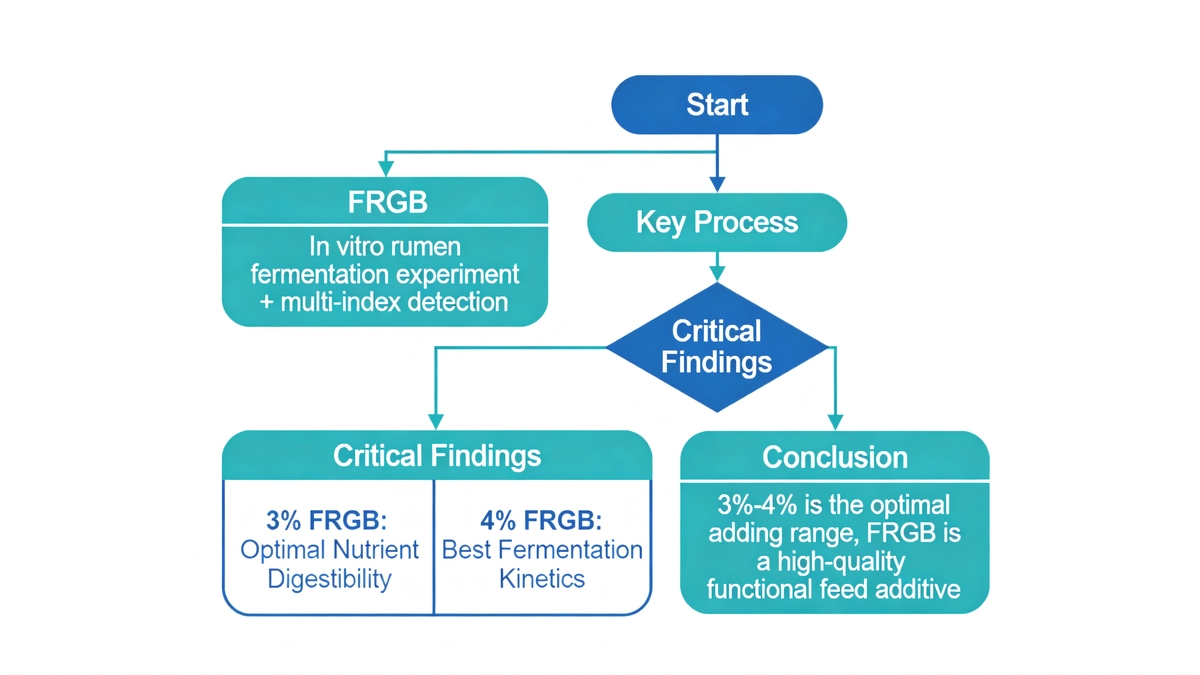
This study systematically evaluated the effects of fermented red ginseng by-product (FRGB) supplementation on rumen fermentation characteristics and nutrient digestibility using in vitro experiments. The results demonstrated significant dose- and time-dependent effects of FRGB on gas production kinetics, with the 4% supplementation level (T4) showing the most favourable performance during the mid- and late fermentation stages, reaching the theoretical maximum gas production. Although all treatments showed a characteristic pattern of increasing gas production, the T4 group maintained greater persistence, indicating optimal substrate composition and effective microbial regulation that sustained fermentation activity. Compared with the control, FRGB slightly reduced the initial gas production rate but significantly improved the overall fermentation potential. The T4 group produced the highest propionic acid concentration and the lowest acetate-to-propionic acid ratio, indicating improved energy utilisation efficiency. Nutrient digestibility analyses showed that 3% FRGB (T3) optimised organic matter digestibility and metabolizable energy, while maximising the neutral detergent fibre and acid detergent fibre degradation, indicating enhanced cellulolytic activity. These differential dosage effects showed functional complementarity: 4% FRGB mainly improved fermentation kinetics and energy release, whereas 3% FRGB enhanced nutrient digestibility and fibre degradation. These results collectively suggest that the optimal addition level of FRGB to ruminant diets is 3–4%, depending on specific production objectives. The present study provides data basis for the evelopment of FRGB as a functional feed additive.
FUNDING
This study was funded by the Natural Science Foundation of Jilin Province (Grant No. YDZJ202101ZYTS105), Department of Agriculture and Rural Affairs of Jilin Province (Grant No. JARS-2024-0703), and Science and Technology Bureau of Yanbian Autonomous Prefecture (Grant No. 2024HZ01).
CONFLICT OF INTEREST
The Authors declare that there is no conflict of interest.
REFERENCES (24)
1.
Baker S.B., Summerson W.H., 1941. The colorimetric determination of lactic acid in biological material. J. Biol. Chem. 138, 535–554, https://doi.org/10.1016/S0021-...
2.
Bayat A.R., Ventto L., Kairenius P., Stefanski T., Leskinen H., Tapio I., Negussie E., Vilkki J., Shingfield K.J., 2017. Dietary forage to concentrate ratio and sunflower oil supplement alter rumen fermentation, ruminal methane emissions and nutrient utilization in lactating cows. Transl. Anim. Sci. 1, 277–286, https://doi.org/10.2527/tas201...
3.
Beauchemin K.A., Kreuzer M., Omara F., Mcallister T.A., 2008. Nutritional management for enteric methane abatement: a review. Aust. J. Exp. Agric. 48, 21–27, https://doi.org/10.1071/EA0719...
4.
Bergman E.N, 1990. Energy contributions of volatile fatty acids from the gastrointestinal tract in various species. Physiol. Rev. 70, 567–590, https://doi.org/10.1152/physre...
5.
Benchaar C., Calsamiglia S., Chaves A.V., Fraser G.R., Colombatto D., McAllister T.A., Beauchemin K.A., 2008. A review of plant-derived essential oils in ruminant nutrition and production. Anim. Feed. Sci. Tech. 145, 209–228, https://doi.org/10.1016/j.anif...
6.
Broderick G.A., Kang J.H., 1980. Automated simultaneous determination of ammonia and total amino acids in ruminal fluid and in vitro media. J. Dairy Sci. 63, 64–75, https://doi.org/10.3168/jds.S0...
7.
Chen X., Su X., Li J., Yang Y., Wang P., Yan F., Yao J., Wu S., 2021. Real-time monitoring of ruminal microbiota reveals their roles in dairy goats during subacute ruminal acidosis. NPJ Biofilms Microbioms 7, 45, https://doi.org/10.1038/s41522...
8.
Chung T.H., Kim C.M., Choi I.H., 2018. A study on growth performance of ducks fed diets with different types of sipjeondaebo-tang byproduct meal and red ginseng marc with fermented red koji and ammonia fluxes in duck litter using alum or aluminum chloride. J. Poult. Sci. 55, 112–116, https://doi.org/10.2141/jpsa.0...
9.
France J., Dijkstra J., Dhanoa M.S., López S., Bannink A., 2000. Estimating the extent of degradation of ruminant feeds from a description of their gas production profiles observed in vitro: derivation of models and other mathematical considerations. Br. J. Nutr. 83, 143–150, https://doi.org/10.1017/s00071...
10.
Huhtanen P., Cabezas-Garcia E.H., Krizsan S.J., Shingfield K.J., 2015. Evaluation of between-cow variation in milk urea and rumen ammonia nitrogen concentrations and the association with nitrogen utilization and diet digestibility in lactating cows. J. Dairy Sci. 98, 3182–3196, https://doi.org/10.3168/jds.20...
11.
Hungate R.E, 1966. The Rumen and Its Microbes. Academic Press. Cambridge, MA (USA).
12.
Itabashi H., Kobayashi T., Matsumoto M., 1984. The effects rumen ciliate protozoa on energy metabolism and some constituents in rumen fluid and blood plasma of goats (in Chinese). Jpn. J. Zootech. Sci. 55, 248–256, https://doi.org/10.2508/chikus...
13.
Johnson K.A., Johnson D.E., 1995. Methane emissions from cattle. J. Anim. Sci. 73, 2483–2492, https://doi.org/10.2527/1995.7...
14.
Kongmun P., Wanapat M., Pakdee P., Navanukraw C., Yu Z., 2011. Manipilation of rumen fermentation and ecology of swamp buffalo by coconut oil and garlic powder supplementation. Livest. Sci. 135, 84–92, https://doi.org/10.1016/j.livs...
15.
Menke K.H., Raab L., Salewski A., Steingass H., Fritz D., Schneider W., 1979. The estimation of the digestibility and metabolizable energy content of ruminant feedingstuffs from the gas production when they are incubated with rumen liquor in vitro. J. Agric. Sci. 93, 217–222, https://doi.org/10.1017/S00218... 00086305
16.
Menke K.H., Steingass H., 1988. Estimation of the energetic feed value obtained from chemical analysis and in vitro gas production using rumen fluid. Anim. Res. Dev. 28, 7–55
17.
Michalski J.P., Czauderna M., Litwin W., Puzio N., Kowalczyk J., 2014. Incorporation of endogenous urea nitrogen into amino acids of milk in goats fed diets with various protein levels. J. Anim. Feed. Sci. 23, 212–216, https://doi.org/10.22358/jafs/...
18.
Mizrahi I., Wallace R.J., Morais S., 2021. The rumen microbiome: balancing food security and environmental impacts. Nat. Rev. Microbiol. 19, 553–566, https://doi.org/10.1038/s41579...
19.
Nyonyo T., Shinkai T., Mitsumori M., 2014. Improved culturability of cellulolytic rumen bacteria and phylogenetic diversity of culturable cellulolytic and xylanolytic bacteria newly isolated from the bovine rumen. FEMS Microbiol. Ecol. 88, 528–537, https://doi.org/10.1111/1574-6...
20.
Pilajun R., Wanapat M., 2011. Effect of coconut oil and mangosteen peel supplementation on ruminal fermentation, microbial population, and microbial protein synthesis in swamp buffaloes. Livest. Sci. 141, 148–154, https://doi.org/10.1016/j.livs...
21.
Priambodo T.W., 2014. Effect of medium-chain fatty acids and ration type on in vitro ruminal methane production. PhD Thesis. Rheinische Friedrich-Wilhelms-Universität Bonn. Bonn (Germany)
22.
Russell J.B., Rychlik J.L., 2001. Factors that alter rumen microbial ecology. Science 292, 1119–1122, https://doi.org/10.1126/scienc....
23.
Tilley J.M.A., Terry R.A., 1963. A two-stage technique for the in vitro digestion of forage crops. J. Br. Grassl. Soc. 18, 104–111, https://doi.org/10.1111/j.1365...
24.
Van Soest P.J., Robertson J.B., Lewis B.A., 1991. Methods for dietary fiber, neutral detergent fiber, and nonstarch polysaccharides in relation to animal nutrition. J. Dairy Sci. 74, 3583–3597, https://doi.org/10.3168/jds.S0...
Share
RELATED ARTICLE
| ISSN: | 1230-1388 |

Assigning DOI numbers, introducing articles from supplements and recent publications to POL-index database, maintaining anti-plagiarism detection, electronic system to proceed manuscripts and webpage of the Journal with interactive pdf files, and language correction of manuscripts published in Journal of Animal and Feed Sciences are financed in the years 2018–2019 by the Ministry of Science and Higher Education from the funds for science popularization activities, Agreement No. 631/P-DUN/2018.

© 2006-2026 Journal hosting platform by Bentus
We process personal data collected when visiting the website. The function of obtaining information about users and their behavior is carried out by voluntarily entered information in forms and saving cookies in end devices. Data, including cookies, are used to provide services, improve the user experience and to analyze the traffic in accordance with the Privacy policy. Data are also collected and processed by Google Analytics tool (more).
You can change cookies settings in your browser. Restricted use of cookies in the browser configuration may affect some functionalities of the website.
You can change cookies settings in your browser. Restricted use of cookies in the browser configuration may affect some functionalities of the website.