Current issue
Online first
Archive
About the Journal
Editorial Office
Editorial Board
Copy right and self-archiving policy
Peer review process
Instructions for Reviewers
Printed version subscription
Abstracting and indexing
Contact
Instructions for Authors
Policies
General information
Open Access, Licensing terms, Commercial use and Copyright terms policies
Self-archiving policy and Archive policies
Article Correction and Withdrawal policy
Manuscript Submission policy
Authorship policy
Conflict of Interest policy
Language considerations policy
Plagiarism and Duplicate publications policy
Ethics policy
Review process policy
Acceptance of manuscripts policy
Online First Articles and Special Issues policies
Generative artificial intelligence (AI) policy
Advertising policy
Article publication charges
Policies
General information
Open Access, Licensing terms, Commercial use and Copyright terms policies
Self-archiving policy and Archive policies
Article Correction and Withdrawal policy
Manuscript Submission policy
Authorship policy
Conflict of Interest policy
Language considerations policy
Plagiarism and Duplicate publications policy
Ethics policy
Review process policy
Acceptance of manuscripts policy
Online First Articles and Special Issues policies
Generative artificial intelligence (AI) policy
Advertising policy

ORIGINAL PAPER
Effect of dietary linseed oil supplementation on nutrients digestibility, in vitro gas production and blood parameters of horses
1
University of Agriculture in Krakow, Faculty of Animal Sciences, Department of Animal Nutrition and Fisheries, al. Mickiewicza 24/28, 30-059 Krakow, Poland
Publication date: 2026-05-04
Corresponding author
A. Waliczek
University of Agriculture in Krakow, Faculty of Animal Sciences, Department of Animal Nutrition and Fisheries, al. Mickiewicza 24/28, 30-059 Krakow, Poland
University of Agriculture in Krakow, Faculty of Animal Sciences, Department of Animal Nutrition and Fisheries, al. Mickiewicza 24/28, 30-059 Krakow, Poland
J. Anim. Feed Sci. 2026;35(2):e24
KEYWORDS
TOPICS
ABSTRACT
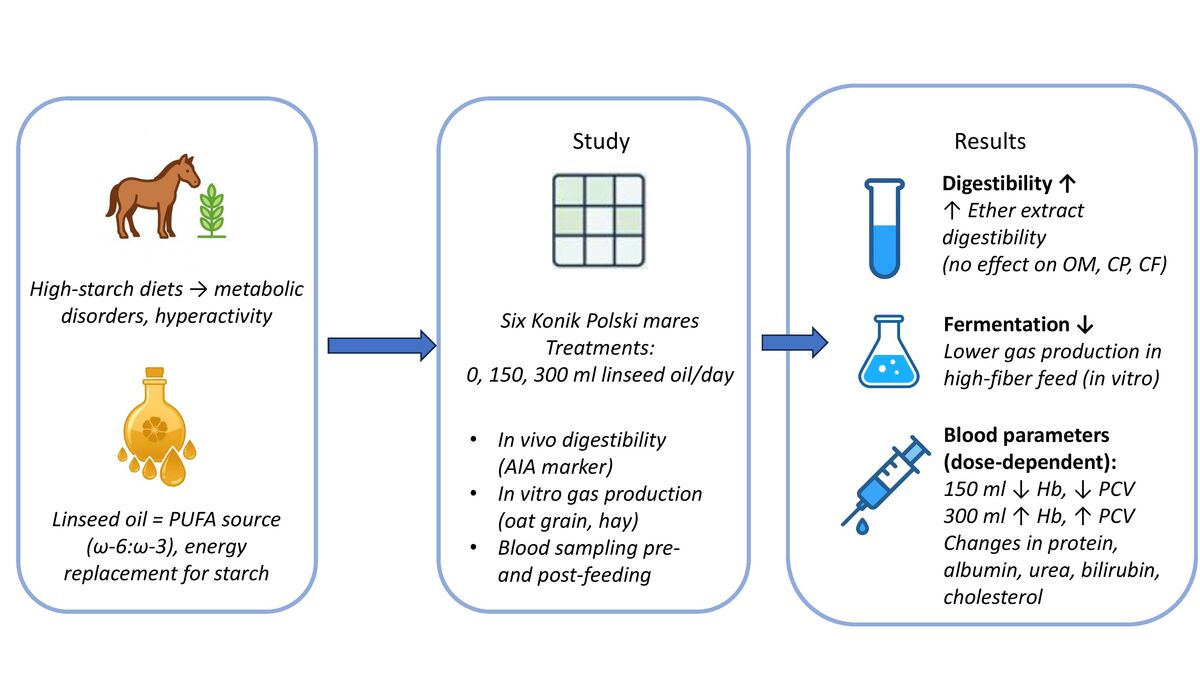
High-starch diets may cause metabolic disorders and hyperactivity
in sport horses. Concentrates based on cereal grains, rich in fermentable starch,
can be partially replaced with vegetable oils. Linseed oil provides essential fatty
acids and has a favourable omega-6 to omega-3 ratio. However, limited data
exist on its dose-dependent effects on digestion and physiology in horses.
This study assessed the impact of two doses of dietary linseed oil on nutrient
digestibility and selected blood parameters in non-working horses. Additionally,
an in vitro gas production (GP) test evaluated microbial fermentation of
selected feeds. Six Konik Polski mares (3–12 years, 200–370 kg body weight) were fed
meadow hay and a concentrate supplemented with 0, 150, or 300 ml/day of
linseed oil. The study was an in vivo digestion experiment employing a 3 × 3
Latin square design. Digestibility was determined using the acid-insoluble ash
(AIA) marker method. Faecal inoculum was used for GP testing with oat grain
and meadow hay. Blood samples were collected before and after feeding to
analyse haematological and biochemical parameters. Linseed oil significantly
improved ether extract digestibility but had no effect on other nutrients. In vitro
GP tended to decrease in high-fibre feed with oil supplementation. The 150 ml
dose lowered haemoglobin and packed cell volume, while 300 ml increased
these values. Significant changes were observed in total protein, albumin, urea,
bilirubin, and cholesterol concentrations. Linseed oil supplementation did not
adversely affect nutrient digestibility and showed dose-dependent influences
on blood parameters, indicating its potential as an alternative energy source in
horse nutrition.
FUNDING
The project was funded by the Ministry of Science and Higher Education of Poland, grant N˚ KW2/34/2020-2024. The authors would like to thank veterinarian Marek Tischner for his kind assistance in providing veterinary care for the horses.
CONFLICT OF INTEREST
The Authors declare that there is no conflict of interest.
REFERENCES (48)
1.
Akhter S., Owen E., Theodorou M.K., Butler E.A., Minson D.J., 1999. Bovine faeces as a source of micro-organisms for the in vitro digestibility assay of forages. Grass Forage Sci. 54, 219–226, https://doi.org/10.1046/j.1365....
2.
Allman M.A., Pena M.M., Pang D., 1995. Supplementation with flaxseed oil versus sunflowerseed oil in healthy young men consuming a low fat diet: effects on platelet composition and function. Eur. J. Clin. Nutr. 49, 169–178.
3.
AOAC International, 2007. Official Methods of Analysis of AOAC International. 18th Edition. Rev. 2. AOAC International. Gaithersburg, MA (USA).
4.
Brooks C.C., Garner G.B., Gehrke C.W., Muhrer M.E., Pfander W.H., 1954. The effect of added fat on the digestion of cellulose and protein by ovine rumen micro-organisms. J. Anim. Sci. 13, 758–764, https://doi.org/10.2527/jas195....
5.
Bush J.A., Freeman D.E., Kline K.H., Merchen N.R., Fahey G.C. Jr., 2001. Dietary fat sup-plementation effects on in vitro nutrient disappearance and in vivo nutrient intake and total tract digestibility by horses. J. Anim. Sci. 79, 232–239, https://doi.org/10.2527/2001.7....
6.
Calder P.C., 2008. The relationship between the fatty acid composition of immune cells and their function. Prostaglandins Leukot. Essent. Fatty Acids 79, 101–108, https://doi.org/10.1016/j.plef....
7.
Casali R.E., Hale J.A., LeNarz L., Faas F., Morris M.D., 1986. Improved graft patency associated with altered platelet function induced by marine fatty acids in dogs. J. Surg. Res. 40, 6–12, https://doi.org/10.1016/0022-4....
8.
Das U.N., 2006. Essential fatty acids - a review. Curr. Pharm. Biotechnol. 7, 467-82, https://doi.org/10.2174/138920....
9.
Dubois M., Gilles K.A., Hamilton J.K., Robers P.A., Smith F., 1956. Colorimetric methods for determination of sugar and related substances. Anal. Chem. 28, 350–356, https://doi.org/10.1021/ac6011....
10.
Dugdale A.H.A., Curtis G.C., Harris P.A., Argo C.M., 2011. Assessment of body fat in the pony: Part I. Relationships between the anatomical distribution of adipose tissue, body composition and body condition. Equine Vet. J. 43, 552–561, https://doi.org/10.1111/j.2042....
11.
Dyerberg J., Bang H.O., Hjorne N., 1975. Fatty acid composition of the plasma lipids in Greenland Eskimos. Am. J. Clin. Nutr. 28, 958–966, https://doi.org/10.1093/ajcn/2....
12.
Faisant N., Planchot V., Kozlowski F., Pacouret M., Colonna P., Champ M., 1995. Resistant starch determination adopted to products containing high level of resistant starch. Chem. Sci. Aliments 15, 83–89.
13.
Frank N., 2011. Equine metabolic syndrome. Vet. Clin. N. Am. Equine Pract. 27, 73–92, https://doi.org/10.1016/j.cveq....
14.
Frota K.M.G., Matias A.C.G., Arêas J.A.G., 2010. Influence of food components on lipid metabolism: scenarios and perspective on the control and prevention of dyslipidemias. Food Sci. Technol. 30, 7–14, https://doi.org/10.1590/S0101-....
15.
Godoi F.N., Almeida F.Q., Migon E.X.F., Almeida H.F.M., Monteiro A.B.F., Santos T.M., 2010. Performance of eventing horses fed high fat diet. Rev. Bras. Zootec. 39, 335–343, https://doi.org/10.1590/S1516-....
16.
Hansen R.A., Savage C.J., Reidlinger K., Traub-Dargatz J.L., Ogilvie G.K., Mitchell D., Fettman M.J., 2002. Effects of dietary flaxseed oil supplementation on equine plasma fatty acid concentrations and whole blood platelet aggregation. J. Vet. Intern. Med. 16, 457–463, .https://doi.org/10.1111/j.1939...
17.
Harris P., 1997. Energy sources and requirements of the exercising horse. Annu. Rev. Nutr. 17, 185–210, https://doi.org/10.1146/annure....
18.
Holland J.L., Kronfeld D.S., Rich G.A., Kline K.A., Fontenot J.P., Meacham T.N., Harris P.A., 1998. Acceptance of fat and lecithin containing diets by horses. Appl. Anim. Behav. Sci. 56, 91–96, https://doi.org/10.1016/S0168-....
19.
Hoyt J.K., Potter G.D., Greene L.W., Vogelsang M.M., Anderson J.G., 1995. Electrolyte balance in exercising horses fed a control and a fat-supplemented diet. J. Equine Vet. Sci. 15, 429–435, https://doi.org/10.1016/S0737-....
20.
Hughes S.J., Potter G.D., Greene L.W., Odom T.W., Murray-Gerzik M., 2010. Adaptation of Thoroughbred horses in training to a fat supplemented diet. Equine Vet. J. 27, 349–352, https://doi.org/10.1111/j.2042....
21.
Jansen W.L., Cone J.W., Geelen S.N.J., Sloet Van Oldruitenborgh-Oosterbaan M.M., Van Gelder A.H., Oude Elferink S.J.W.H., Beynen A.C., 2007. High fat intake by ponies reduces both apparent digestibility of dietary cellulose and cellulose fermentation by faeces and isolated caecal and colonic contents. Anim. Feed Sci. Technol. 133, 298–308, https://doi.org/10.1016/j.anif....
22.
Jansen W.L., Geelen S.N.J., Van Der Kuilen J., Beynen A.C., 2002. Dietary soyabean oil depresses the apparent digestibility of fibre in trotters when substituted for an iso-energetic amount of corn starch or glucose. Equine Vet. J. 34, 302-305, https://doi.org/10.2746/042516....
23.
Jansen W.L., Van Der Kuilen J., Geelen S.N.J., Beynen A.C., 2000. The effect of replacing nonstructural carbohydrates with soybean oil on the digestibility of fibre in trotting horses. Equine Vet. J. 32, 27–20, https://doi.org/10.2746/042516....
24.
Jansen W.L., Van Der Kuilen J., Geelen S.N.J., Beynen A.C., 2001. The apparent digestibility of fibre in trotters when dietary soybean oil is substituted for an iso-energetic amount of glucose. Arch. Anim. Nutr. 54, 297–304, https://doi.org/10.1080/174503....
25.
Johnson A.C.B., Rossow H.A., 2018. Effects of two equine digestive aid supplements on hindgut health. Transl. Anim. Sci. 3, 340–349, https://doi.org/10.1093/tas/tx....
26.
Julen T.R., Potter G.D., Greene L.W., Stott G.G., 1995. Adaptation to a fat-supplemented diet by cutting horses. J. Equine Vet. Sci. 15, 436–440, https://doi.org/10.1016/S0737-....
27.
Julliand V., De Fombelle A., Varloud M., 2006. Starch digestion in horses: The impact of feed processing. Livest. Sci. 100, 44–52, https://doi.org/10.1016/j.livp....
28.
Kronfeld D.S., 1996. Dietary fat affects heat production and other variables of equine performance, under hot and humid conditions. Equine Vet J. 28, 24–34, https://doi.org/10.1111/j.2042....
29.
Kronfeld D.S., Harris P.A., 2003. Equine grain-associated disorders. Compend. Contin. Educ. Pract. Vet. 25, 974-983.
30.
Kronfeld D.S., Holland J.L., Rich G.A., Meacham T.N., Fontenot J.P., Sklan D.J., Harris P.A., 2004. Fat digestibility in Equus caballus follows increasing first-order kinetics. J. Anim. Sci. 82, 1773–1780, https://doi.org/10.2527/2004.8....
31.
Lowman R.S., 1998. Investigations into the factors which influence measurements during in vitro gas production studies. PhD Thesis, University of Edinburgh (UK).
32.
Macheboeuf D., Jestin M., Andrieu J., Martin-Rosset W., 1998. Prediction of the organic matter digestibility of forages in horses by the gas test method. BSAP Occasional Publication 22, 252–254, https://doi.org/10.1017/S02639....
33.
Materac E., Marczyński Z., Bodek K.H., 2013. The role of omega-3 and omega-6 fatty acids in the human body (in Polish). Bromat. Chem. Toksykol. 45, 225-233.
34.
Menke K., Raab L., Salewski A., Steingass H., Fritz D., Schneider W., 1979. The estimation of the digestibility and metabolizable energy content of ruminant feeding stuffs from the gas production when they are incubated with rumen liquor in vitro. J. Agric. Sci. 93, 217–222, https://doi.org/10.1017/S00218....
35.
Menke K.H., Steingass H., 1988. Estimation of the energetic feed value obtained from chemical analysis and in vitro gas production using rumen fluid. Anim. Res. Develop. 28, 7–55.
36.
Mertens D.R., 2002. Gravimetric determination of amylase-treated neutral detergent fibre in feeds with refluxing in beakers or crucibles: collaborative study. J. AOAC Int. 85, 1217–1240, https://doi.org/10.1093/jaoac/....
38.
NRC (National Research Council), 2007. Nutrient Requirements of Horses. National Academies Press. Washington, DC (USA).
39.
Patoux S., Istasse L., 2016. Incorporation of sunflower oil or linseed oil in equine compound feedstuff: 1 Effects on haematology and on fatty acids profiles in the red blood cells membranes. J. Anim. Physiol. Anim. Nutr. 100, 828-835, https://doi.org/10.1111/jpn.12....
40.
Potter S.J., Bamford N.J., Baskerville C.L., Harris P.A., Bailey S.R., 2022. Comparison of feed digestibility between ponies, standardbreds and andalusian horses fed three different diets. Vet. Sci. 9, 15, https://doi.org/10.3390/vetsci....
41.
Robertson J.B., Van Soest P., 1981. The detergent system of analysis and its application to human foods. In: W.P.T. James, O. Theander (Editors). The Analysis of Dietary Fiber in Food. Marcel Dekker. New York (USA).
42.
Saastamoinen M., Särkijärvi S., 2020. Effect of linseed (Linum usitatissimum) groats-based mixed feed supplements on diet nutrient digestibility and blood parameters of horses. Animals 10, 272, https://doi.org/10.3390/ani100....
43.
Sembratowicz I., Zięba G., Cholewinska E., Czech A., 2020. Effect of dietary flaxseed oil supplementation on the redox status, haematological and biochemical parameters of horses’ blood. Animals 10, 2244, https://doi.org/10.3390/ani101....
44.
Van Keulen J.V., Young B.A., 1977. Evaluation of acid-insoluble ash as a natural marker in ruminant digestibility studies. J. Anim. Sci. 44, 282–287, https://doi.org/10.2527/jas197....
45.
Warren L.K., Kivipelto J., 2007. Fatty acid content of grass and legume hays commonly fed to horses. J. Anim. Sci. 85, 140–141, https://www.adsa.org/Portals/0....
46.
Warren L.K., Vineyard K.L., 2013. Fat and fatty acids. In: R. Geor, P. Harris, M. Coenen (Editors). Equine Applied and Clinical Nutrition. Saunders. (UK), pp. 136–155, https://doi.org/10.1016/B978-0....
47.
Webb A.I., Weaver B.M.Q., 1979. Body composition of the horse. Equine Vet. J. 11, 39–47, https://doi.org/10.1111/j.2042....
48.
Zeyner A.C, Bessert J., Gropp J.M., 2002. Effect of feeding exercised horses on high-starch or high-fat diets for 390 days. Equine Vet. J. Suppl. 34, 50–57, https://doi.org/10.1111/j.2042....
Share
RELATED ARTICLE
| ISSN: | 1230-1388 |

Assigning DOI numbers, introducing articles from supplements and recent publications to POL-index database, maintaining anti-plagiarism detection, electronic system to proceed manuscripts and webpage of the Journal with interactive pdf files, and language correction of manuscripts published in Journal of Animal and Feed Sciences are financed in the years 2018–2019 by the Ministry of Science and Higher Education from the funds for science popularization activities, Agreement No. 631/P-DUN/2018.

© 2006-2026 Journal hosting platform by Bentus
We process personal data collected when visiting the website. The function of obtaining information about users and their behavior is carried out by voluntarily entered information in forms and saving cookies in end devices. Data, including cookies, are used to provide services, improve the user experience and to analyze the traffic in accordance with the Privacy policy. Data are also collected and processed by Google Analytics tool (more).
You can change cookies settings in your browser. Restricted use of cookies in the browser configuration may affect some functionalities of the website.
You can change cookies settings in your browser. Restricted use of cookies in the browser configuration may affect some functionalities of the website.