Current issue
Online first
Archive
About the Journal
Editorial Office
Editorial Board
Copy right and self-archiving policy
Peer review process
Instructions for Reviewers
Printed version subscription
Abstracting and indexing
Contact
Instructions for Authors
Policies
General information
Open Access, Licensing terms, Commercial use and Copyright terms policies
Self-archiving policy and Archive policies
Article Correction and Withdrawal policy
Manuscript Submission policy
Authorship policy
Conflict of Interest policy
Language considerations policy
Plagiarism and Duplicate publications policy
Ethics policy
Review process policy
Acceptance of manuscripts policy
Online First Articles and Special Issues policies
Generative artificial intelligence (AI) policy
Advertising policy
Article publication charges
Policies
General information
Open Access, Licensing terms, Commercial use and Copyright terms policies
Self-archiving policy and Archive policies
Article Correction and Withdrawal policy
Manuscript Submission policy
Authorship policy
Conflict of Interest policy
Language considerations policy
Plagiarism and Duplicate publications policy
Ethics policy
Review process policy
Acceptance of manuscripts policy
Online First Articles and Special Issues policies
Generative artificial intelligence (AI) policy
Advertising policy

ORIGINAL PAPER
Alternative tannin sources in post-weaning piglets:
impact of Lythrum salicaria and Bistorta officinalis
on health and performance
1
Institute of Animal Nutrition, Department of Veterinary Medicine, Freie Universität Berlin,
Königin-Luise-Straße 49, 14195 Berlin, Germany
2
Microbiota Lab, Faculty of Pharmacy, Department of Pharmaceutical Microbiology and Bioanalysis,
Medical University of Warsaw, Banacha street 1, 02-097 Warsaw, Poland
3
Faculty of Pharmacy, Department of Pharmaceutical Biology,
Medical University of Warsaw, Banacha street 1, 02-097 Warsaw, Poland
Publication date: 2026-06-03
Corresponding author
P. Krüsselmann
Institute of Animal Nutrition, Department of Veterinary Medicine, Freie Universität Berlin, Königin-Luise-Straße 49, 14195 Berlin, Germany
Institute of Animal Nutrition, Department of Veterinary Medicine, Freie Universität Berlin, Königin-Luise-Straße 49, 14195 Berlin, Germany
J. Anim. Feed Sci. 2026;35(3):e39
KEYWORDS
TOPICS
ABSTRACT
Tannins have attracted increasing interest as dietary components
for the prevention of post-weaning diarrhoea in piglets. The objective of this
study was to investigate the effects of dietary supplementation with an extract
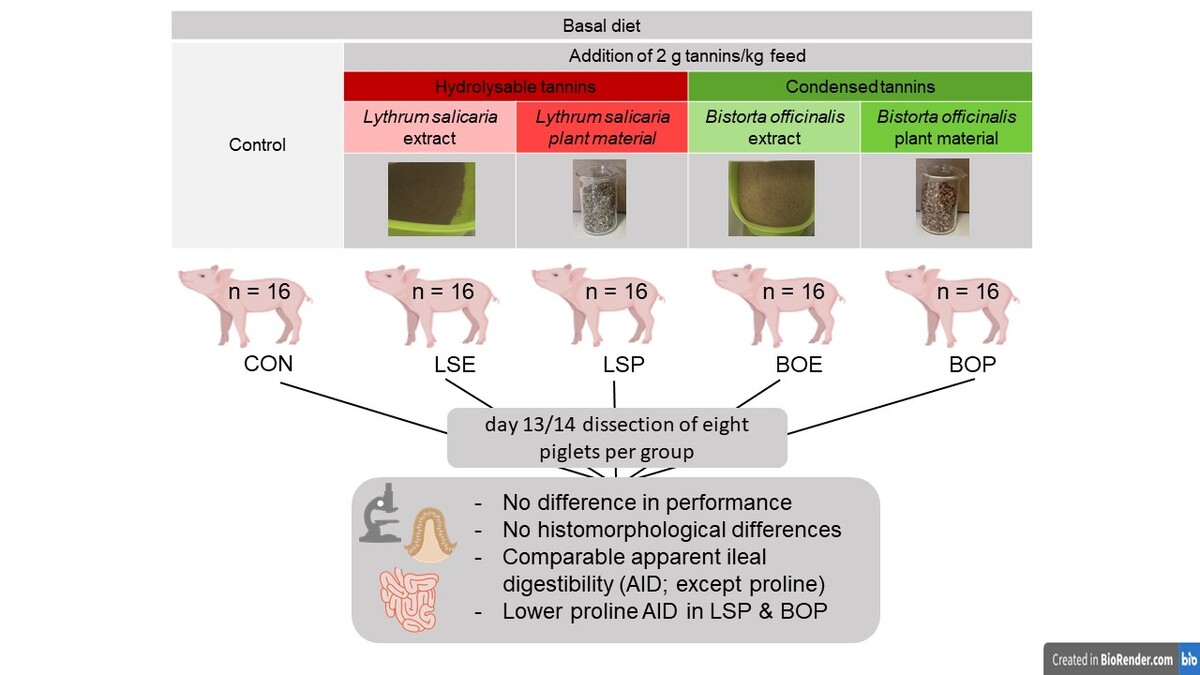
or plant material derived from Lythrum salicaria L. and Bistorta officinalis. Eighty
weaned piglets (40 males and 40 females) were randomly divided into five
treatment groups: control (CON), L. salicaria extract (LSE), B. officinalis extract
(BOE), L. salicaria plant material (LSP), and B. officinalis plant material (BOP).
Treatment diets were formulated to provide an equal tannin supplementation
level (2 g/kg feed). Animals were slaughtered on days 13 and 14 of the trial.
Intestinal digesta, faeces and tissue samples (duodenum, mid jejunum) were
collected to analyse pH, ileal and total tract apparent nutrient digestibility (AID
and ATTD), and histomorphological parameters. No significant differences were
observed in performance and most histomorphological traits. Inclusion of LSP
and BOP lowered AID of proline in comparison to CON (P = 0.044). The LSP
group had the lowest arginine (P = 0.003) and histidine ATTD (P = 0.004). Both
the LSP and BOP groups had reduced ATTD of glutamic acid (P = 0.003) and
proline (P < 0.001), while BOP additionally showed the lowest proline ATTD.
In conclusion, L. salicaria and B. officinalis supplementation did not adversely
affect piglet performance, although reductions in the digestibility of several
amino acids were recorded. These moderate effects suggest that tannins from
L. salicaria and B. officinalis can be considered safe for piglet diets at the tested
inclusion levels.
ACKNOWLEDGEMENTS
We would like to express our gratitude to Luisa
Ebersbach, Anett Kriesten, Katharina Schröter,
Leila Al-Khalisi, Małgorzata Lipowska, Monika
Marciniak, Sebastian Doktór for their support
with the laboratory analyses. We also want to thank
the animal caretakers Ines Bebert, Joana Bebert,
Lisa Gronau, Sandra Fischer, and Sascha Günter for
their excellent work during the animal trial.
FUNDING
The authors acknowledge support from the
Polish National Science Centre and Deutsche
Forschungsgemeinschaft research grant OPUS
LAP UMO-2020/39/I/NZ7/02547.
CONFLICT OF INTEREST
The Authors declare that there is no conflict of
interest.
ADDITIONAL INFORMATION
The Authors declare that AI-assisted tools
were used solely to improve the language and clarity
of the manuscript. Specifically, DeepL (free
translator; https://www.deepl.com/de/translator)
and ChatGPT (version: 5.2) were employed for
linguistic refinement. No AI tools were used for data analysis, interpretation, or the generation of scientific content.
REFERENCES (53)
1.
AOCS (American Oli Chemists’ Society), 2017. Standard procedure Ba 6a-05. Crude fiber in feed by filter bag technique. IL, USA: AOCS Press
2.
Bankhead P., Loughrey M.B., Fernández J.A. et al., 2017. QuPath: Open source software for digital pathology image analysis. Sci. Rep. 7, 16878, https://doi.org/10.1038/s41598...
3.
Biagi G., Cipollini I., Paulicks B.R., Roth F.X., 2010. Effect of tannins on growth performance and intestinal ecosystem in weaned piglets. Arch. Anim. Nutr. 64, 121–135, https://doi.org/10.1080/174503...
4.
Cappai M. G., Wolf P., Pinna W., Kamphues J., 2013. Pigs use endogenous proline to cope with acorn (Quercus pubescens Willd.) combined diets high in hydrolysable tannins. Livest. Sci. 155, 316–322, https://doi.org/10.1016/j.livs...
5.
Caprarulo V., Giromini C., Rossi L., 2021. Review: Chestnut and quebracho tannins in pig nutrition: The effects on performance and intestinal health. Animal 15, 100064, https://doi.org/10.1016/j.anim...
6.
Commission Regulation (EC), 2009. No 152/2009 of 27 January 2009 laying down the methods of sampling and analysis for the official control of feed. Off. J. Eur. Union L54, 42–46
7.
Degano I., Mattonai M., Sabatini F., Colombini M.P., 2019. A mass spectrometric study on tannin degradation within dyed woolen yarns. Molecules 24, 2318, https://doi.org/10.3390/molecu...
8.
Deng Z.C., Wang J., Wang J., Yan Y.Q., Huang Y.X., Chen C.Q., Sun L.h., Liu M., 2024. Tannic acid extracted from gallnut improves intestinal health with regulation of redox homeostasis and gut microbiota of weaned piglets. Anim. Res. One Health. 2, 16–27, https://doi.org/10.1002/aro2.5...
9.
Directive, EUs, 2010. 63/EU of the European Parliament and of the Council of 22 September 2010 on the protection of animals used for scientific purposes. Off. J. Eur. Union 276, 33–79
10.
El-Shazly A., Ateya A. M., Wink M., 2001. Quinolizidine alkaloid profiles of Lupinus varius orientalis, L. albus albus, L. hartwegii, and L. densiflorus. Z. Naturforsch. C. J. Biosci. 56, 21–30, https://doi.org/10.1515/znc-20...
11.
European Pharmacopoeia, 2019. European Pharmacopoeia, 10th Ed., Council of Europe, Strasbourg
12.
Fanali C., Inzitari R., Cabras T., Fiorita A., Scarano E., Patamia M., Petruzzelli R., Bennick A., Messana I., Castagnola M., 2008. Mass spectrometry strategies applied to the characterization of proline-rich peptides from secretory parotid granules of pig (Sus scrofa). J. Sep. Sci. 31, 516–522, https://doi.org/10.1002/jssc.2...
13.
Galassi G., Federico M., Luca R., M. C. G., and Spanghero M., 2019. Digestibility and metabolic utilisation of diets containing chestnut tannins and their effects on growth and slaughter traits of heavy pigs. Ital. J. Anim. Sci. 18, 746–753, https://doi.org/10.1080/182805...
14.
Gericke S., Kurmies B., 1952. Colorimetric determination of phosphoric acid with vanadate-molybdate (VM-Method) (in German). Z. Anal. Chem. 137, 15–22
15.
GfE (Society for Nutritional Physiology, in German), 2006. Recommendations for energy and nutrient supply for pigs (in German). Frankfurt am Main, Germany: DLG-Verlags-GmbH
16.
GfE (Society for Nutritional Physiology, in German), 2008. Prediction of metabolisable energy of compound feeds for pigs. Proceedings of the society of nutrition physiology 17
17.
Girard M., Bee G., 2020. Invited review: Tannins as a potential alternative to antibiotics to prevent coliform diarrhea in weaned pigs. Animal 14, 95–107, https://doi.org/10.1017/S17517...
18.
Gresse R., Chaucheyras-Durand F., Fleury M.A., Van de Wiele T., Forano E., Blanquet-Diot S., 2017. Gut microbiota dysbiosis in postweaning piglets: Understanding the keys to health. Trends Microbiol. 25, 851–873, https://doi.org/10.1016/j.tim....
20.
Hassan Z. M., Manyelo T. G., Selaledi L., Mabelebele M., 2020. The effects of tannins in monogastric animals with special reference to alternative feed ingredients. Molecules 25, 4680, https://doi.org/10.3390/molecu...
21.
Huang Q., Liu X., Zhao G., Hu T., Wang Y., 2018. Potential and challenges of tannins as an alternative to in-feed antibiotics for farm animal production. Anim. Nutr. 4, 137–150, https://doi.org/10.1016/j.anin...
22.
Huang Q., Yang W., Li X., Xie L., Tang D., Qian Z., 2024. Screening of α-glucosidase inhibitors in extracts of Polygonum bistorta based on spectrum-effect relationship. J. Exp. Clin. Appl. Chin. Med. 5, 69–81, https://doi.org/10.62767/jecac...
23.
Ivanov S.A., Nomura K., Malfanov I.L., Sklyar I.V., Ptitsyn L.R., 2011. Isolation of a novel catechin from Bergenia rhizomes that has pronounced lipase-inhibiting and antioxidative properties. Fitoterapia 82, 212–218, https://doi.org/10.1016/j.fito...
24.
Lallès J.P., Bosi P., Smidt H., Stokes C.R., 2007. Nutritional management of gut health in pigs around weaning. P. Nutr. Soc. 66, 260–268, https://doi.org/10.1017/S00296...
25.
Li Q.H., Yan H.S., Li H.Q., Gao J.J., Hao R.R., 2020. Effects of dietary supplementation with grape seed procyanidins on nutrient utilisation and gut function in weaned piglets. Animal 14, 491–498, https://doi.org/10.1017/S17517...
26.
Liu P., Pieper R., Rieger J., Vahjen W., Davin R., Plendl J., Meyer W., Zentek J., 2014. Effect of dietary zinc oxide on morphological characteristics, mucin composition and gene expression in the colon of weaned piglets. PLOS One 9, e91091, https://doi.org/10.1371/journa...
27.
Ma M., Chambers J.K., Uchida K., Ikeda M., Watanabe M., Goda Y., Yamanaka D., Takahashi S. I., Kuwahara M., Li J.Y., 2021. Effects of supplementation with a quebracho tannin product as an alternative to antibiotics on growth performance, diarrhea, and overall health in early-weaned piglets. Animals 11, 3316, https://doi.org/10.3390/ani111...
28.
Ma M., Enomoto Y., Takahashi T., Uchida K., Chambers J.K., Goda Y., Yamanaka D., Takahashi S.I., Kuwahara M., Li J., 2024. Study of the effects of condensed tannin additives on the health and growth performance of early-weaned piglets. Animals 14, 2337, https://doi.org/10.3390/ani141...
29.
Makkar H. P. S., Blümmel M., Borowy N. K., Becker K., 1993. Gravimetric determination of tannins and their correlations with chemical and protein precipitation methods. J. Sci. Food Agric. 61, 161–165, https://doi.org/10.1002/jsfa.2...
30.
Mariscal-Landín G., Avellaneda J.H., Reis de Souza T.C., Aguilera A., Borbolla G.A., Mar B., 2004. Effect of tannins in sorghum on amino acid ileal digestibility and on trypsin (E.C.2.4.21.4) and chymotrypsin (E.C.2.4.21.1) activity of growing pigs. Anim. Feed Sci. Tech. 117, 245–264, https://doi.org/10.1016/j.anif...
31.
McDonald S., Prenzler P.D., Antolovich M., Robards K., 2001. Phenolic content and antioxidant activity of olive extracts. Food Chem. 73, 73–84, https://doi.org/10.1016/S0308-...
32.
Myrie S. B., Bertolo R. F., Sauer W. C., Ball R. O., 2008. Effect of common antinutritive factors and fibrous feedstuffs in pig diets on amino acid digestibilities with special emphasis on threonine. J. Anim. Sci. 86, 609–619, https://doi.org/10.2527/jas.20...
33.
Pan L., Feng S., Li W., Zhu W., 2022. Comparative digestion and fermentation characteristics of low-tannin or high-tannin sorghum grain in the porcine gastrointestinal tract. J. Anim. Sci. 100, skac300, https://doi.org/10.1093/jas/sk...
34.
Pawłowska K. A., Hałasa R., Dudek M. K., Majdan M., Jankowska K., Granica S., 2020. Antibacterial and anti-inflammatory activity of bistort (Bistorta officinalis) aqueous extract and its major components. Justification of the usage of the medicinal plant material as a traditional topical agent. J. Ethnopharmacol. 260, 113077, https://doi.org/10.1016/j.jep....
35.
Piwowarski J.P., Granica S., Kiss A.K., 2015. Lythrum salicaria L.-Underestimated medicinal plant from european traditional medicine. A review. J. Ethnopharmacol. 170, 226–250, http://dx.doi.org/10.1016/j.je...
36.
Piwowarski J.P., Kiss A.K., 2013. C-glucosidic ellagitannins from Lythri herba (European pharmacopoeia): Chromatographic profile and structure determination. Phytochem. Anal. 24, 336–348, https://doi.org/10.1002/pca.24...
37.
Rajković E., Schwarz C., Tischler D. et al., 2021. Potential of grape extract in comparison with therapeutic dosage of antibiotics in weaning piglets: Effects on performance, digestibility and microbial metabolites of the ileum and colon. Animals 11, 2771, https://doi.org/10.3390/ani111...
38.
Rauha J.P., Wolfender J.L., Salminen J.P., Pihlaja K., Hostettmann K., Vuorela H., 2001. Characterization of the polyphenolic composition of purple loosestrife (Lythrum salicaria). Z. Naturforsch. C. J. Biosci. 56, 13–20, https://doi.org/10.1515/znc-20...
39.
Regulation (EC) No 1831/2003 of the European Parliament and of the Council of 22 September 2003 on additives for use in animal nutrition, chapter II article 11. L268, 18/10/2003, https://eur-lex.europa.eu/LexU... (accessed at 21.07.2025).
40.
Scalbert A., 1991. Antimicrobial properties of tannins. Phytochemistry 30, 3875–3883, https://doi.org/10.1016/0031-9...
41.
Song Y., Luo Y., Yu B. et al., 2021. Tannic acid extracted from gallnut prevents post-weaning diarrhea and improves intestinal health of weaned piglets. Anim. Nutr. 7, 1078–1086, https://doi.org/10.1016/j.anin...
42.
Souza K.L.d., Dias C.P., Callegari M.A., Friderichs A., Paes A.O.S., de Carvalho R.H., da Silva C.A., 2025. Performance and intestinal health of piglets in the nursery phase subjected to diets with condensed black wattle (Acacia mearnsii) tannin. Anim. Biosci. 38, 117–130, https://doi.org/10.5713/ab.24....
43.
Steendam C.A., Tamminga S., Boer H., de Jong E.-J., Visser G.H., Verstegen M.W.A., 2004. Ileal endogenous nitrogen recovery is increased and its amino acid pattern is altered in pigs fed quebracho extract. J. Nutr. 134, 3076–3082, https://doi.org/10.1093/jn/134...
44.
Tanaka T., Watanabe N., Kato T., Aoki R., Ogiso T., Sugiyama A., Tomita E., 2020. Utility of direct fast scarlet staining in the histopathological diagnosis of eosinophilic esophagitis: A short report. Gastrointest. Disord. 2, 448–455, https://doi.org/10.3390/gidiso...
45.
Tang H. R., Covington A. D., Hancock R. A., 2003. Structure–activity relationships in the hydrophobic interactions of polyphenols with cellulose and collagen. Biopolymers 70, 403–413, https://doi.org/10.1002/bip.10...
46.
VDLUFA. 1976. VDLUFA. Methodology book Volume III. The chemical analysis of animal feed (in German). Darmstadt, Germany: VDLUFA-Verlag
47.
Wang M., Huang H., Hu Y., Huang J., Yang H., Wang L., Chen S., Chen C., He S., 2020. Effects of dietary microencapsulated tannic acid supplementation on the growth performance, intestinal morphology, and intestinal microbiota in weaning piglets. J. Anim. Sci. 98, skaa112, https://doi.org/10.1093/jas/sk...
48.
Wang S.-T., Yang H., Gao W., Li H.-J., Li P., 2016. Trace enrichment and characterization of polyphenols in bistort rhizoma using weak anion-exchange solid phase extraction and high performance liquid chromatography-quadrupole time-of-flight mass spectrometry. J. Pharm. Biomed. Anal. 119, 91–98, https://doi.org/10.1016/j.jpba...
49.
Xu T.T., Ma X., Zhou X.C., Qian M.Q., Yang Z.R., Cao P.W., Han X.Y., 2022. Coated tannin supplementation improves growth performance, nutrients digestibility, and intestinal function in weaned piglets. J. Anim. Sci. 100, skac088, https://doi.org/10.1093/jas/sk...
50.
Yang W.-Q., Qian Z.-M., Wu M.-Q., Gao J.-L., Huang Q., Zou Y.-S., Tang D., 2023. Online microextraction coupled with HPLC-ABTS for rapid analysis of antioxidants from the root of Polygonum bistorta. Evid‐Based. Compl. Alt. Med. 7496848, https://doi.org/10.1155/2023/7...
51.
Yang Y.-n., Li F.-s., Liu F., Feng Z.-m., Jiang J.-s., Zhang P.-c., 2016. A novel adduct of ECG fused to piceid and four new dimeric stilbene glycosides from Polygonum cuspidatum. Rsc. Adv. 6, 60741–60748, https://doi.org/10.1039/C6RA11...
52.
Yu J., Song Y., Yu B. et al., 2020. Tannic acid prevents post-weaning diarrhea by improving intestinal barrier integrity and function in weaned piglets. J. Anim. Sc.i Biotechnol. 11, 87, https://doi.org/10.1186/s40104...
53.
Yu S. J., Kong X. B., Jin X. et al., 2025. Systematic elucidation of the effective constituents and potential mechanisms of scrophulariae radix against neoplasm based on lc-ms, network pharmacology, and molecular docking approaches. Front. Plant Sci. 16, 1615076, https://doi.org/10.3389/fpls.2...
Share
RELATED ARTICLE
| ISSN: | 1230-1388 |

Assigning DOI numbers, introducing articles from supplements and recent publications to POL-index database, maintaining anti-plagiarism detection, electronic system to proceed manuscripts and webpage of the Journal with interactive pdf files, and language correction of manuscripts published in Journal of Animal and Feed Sciences are financed in the years 2018–2019 by the Ministry of Science and Higher Education from the funds for science popularization activities, Agreement No. 631/P-DUN/2018.

© 2006-2026 Journal hosting platform by Bentus
We process personal data collected when visiting the website. The function of obtaining information about users and their behavior is carried out by voluntarily entered information in forms and saving cookies in end devices. Data, including cookies, are used to provide services, improve the user experience and to analyze the traffic in accordance with the Privacy policy. Data are also collected and processed by Google Analytics tool (more).
You can change cookies settings in your browser. Restricted use of cookies in the browser configuration may affect some functionalities of the website.
You can change cookies settings in your browser. Restricted use of cookies in the browser configuration may affect some functionalities of the website.