Current issue
Online first
Archive
About the Journal
Editorial Office
Editorial Board
Copy right and self-archiving policy
Peer review process
Instructions for Reviewers
Printed version subscription
Abstracting and indexing
Contact
Instructions for Authors
Policies
General information
Open Access, Licensing terms, Commercial use and Copyright terms policies
Self-archiving policy and Archive policies
Article Correction and Withdrawal policy
Manuscript Submission policy
Authorship policy
Conflict of Interest policy
Language considerations policy
Plagiarism and Duplicate publications policy
Ethics policy
Review process policy
Acceptance of manuscripts policy
Online First Articles and Special Issues policies
Generative artificial intelligence (AI) policy
Advertising policy
Article publication charges
Policies
General information
Open Access, Licensing terms, Commercial use and Copyright terms policies
Self-archiving policy and Archive policies
Article Correction and Withdrawal policy
Manuscript Submission policy
Authorship policy
Conflict of Interest policy
Language considerations policy
Plagiarism and Duplicate publications policy
Ethics policy
Review process policy
Acceptance of manuscripts policy
Online First Articles and Special Issues policies
Generative artificial intelligence (AI) policy
Advertising policy

ORIGINAL PAPER
Is the impact of copper nanoparticles on the immune system
of rats dependent on the diverse physiological functions
of dietary fibre?
1
University of Life Sciences in Lublin, Faculty of Animal Sciences and Bioeconomy, Department of Biochemistry and Toxicology,
Akademicka 13, 20-950 Lublin, Poland
2
Polish Academy of Sciences, InLife Institute of Animal Reproduction and Food Research,
Trylińskiego 18, 10-683 Olsztyn, Poland
3
Casimir Pulaski Radom University, Faculty of Medical and Health Sciences, Department of Non-Procedural Clinical Sciences,
Bolesława Chrobrego 27, 26-600 Radom, Poland
4
Casimir Pulaski Radom University, Faculty of Medical and Health Sciences,
Clinical Department of Cardiology with Electrotherapy Laboratory, Juliana Aleksandrowicza 5, 26-617 Radom, Poland
Publication date: 2026-05-28
Corresponding author
K. Ognik
University of Life Sciences in Lublin, Faculty of Animal Sciences and Bioeconomy, Department of Biochemistry and Toxicology, Akademicka 13, 20-950 Lublin, Poland
University of Life Sciences in Lublin, Faculty of Animal Sciences and Bioeconomy, Department of Biochemistry and Toxicology, Akademicka 13, 20-950 Lublin, Poland
J. Anim. Feed Sci. 2026;35(3):e32
KEYWORDS
TOPICS
ABSTRACT
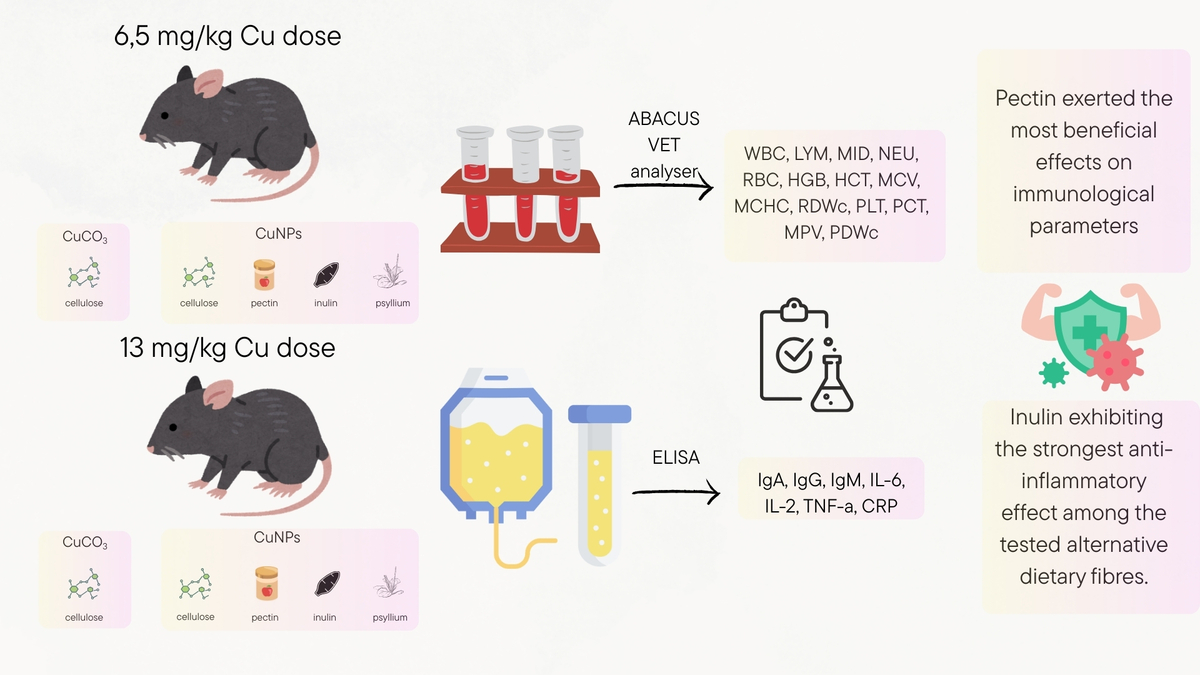
A six-week feeding trial was conducted to evaluate the effects of
dietary supplementation with copper nanoparticles (CuNPs) administered at
6.5 or 13.0 mg Cu/kg diet, in combination with different types of dietary fibre,
on haematological and immune parameters in rats. Ten experimental groups
were included. Two control groups received cellulose-based diets containing
copper(II) carbonate(CuCO3) at 6.5 or 13.0 mg Cu/kg diet. In the experimental
groups, CuCO3 was replaced with CuNPs at the corresponding concentrations,
and diets were supplemented with various fibre types: cellulose, pectin, inulin,
or psyllium. At the end of the experimental period, blood samples were collected
for the assessment of haematological and immune indices. Irrespective of Cu
form or dose, diets containing pectin or inulin lowered the counts of white blood
cells (WBC) and lymphocytes (LYM), while inulin or psyllium reduced interleukin
6 (IL-6) concentrations. In contrast, CuNPs administered at 6.5 mg Cu/kg diet in
combination with psyllium increased WBC and LYM counts. The inclusion of inulin
or psyllium in diets containing the lower CuNPs dose decreased immunoglobulin
M (IgM), IL-6, and tumour necrosis factor α (TNF-α) levels. Replacing CuCO3
with CuNPs at 6.5 mg Cu/kg in diets containing cellulose, inulin, or psyllium
lowered immunoglobulin A (IgA) levels, while cellulose additionally increased
C-reactive protein (CRP) concentrations. A diet containing double dose of
CuNPs (13.0 mg Cu/kg) with psyllium reduced mean corpuscular haemoglobin
(MCH) and increased red cell distribution width (RDWc) and mean platelet
volume (MPV). Moreover, high-dose CuNPs diets containing pectin, inulin,
or psyllium lowered IgA, IgM, interleukin 2 (IL-2), and TNF-α concentrations,
and pectin additionally reduced immunoglobulin G (IgG) levels. In summary,
replacing standard CuCO3 with CuNPs, even at 6.5 mg Cu/kg diet, induced
inflammation and impaired immune function in rats. However, supplementation
with pectin or inulin alleviated the adverse immune and inflammatory effects
caused by Cu nanoparticles.
FUNDING
This research was supported by National Science Centre, Poland, Grant No. 2021/41/B/NZ9/01104.
CONFLICT OF INTEREST
The Authors declare that there is no conflict of interest.
REFERENCES (58)
1.
Aggett P.J., Fairweather-Tait S., 1998. Adaptation to high and low copper intakes: its relevance to estimated safe and adequate daily dietary intakes. Am. J. Clin. Nutr. 67, 1061S–1063S, https://doi.org/10.1093/ajcn/6...
2.
Al-Ruwad S.H., Attia A.I., Abdel Monem U.M., Abdel-Maksoud A., Thagfan F.A. Alqahtani H.A, Alkahtani A.M., Salah A.S., Reda F.M., 2024. Dietary supplementation with copper nanoparticles enhances broiler performance by improving growth, immunity, digestive enzymes, and gut microbiota. Poult. Sci. 103, 104026, https://doi.org/10.1016/j.psj....
3.
Angelova M., Asenova S., Nedkova V., Koleva-Kolarova R., 2011. Copper in the human organism. Trakia J. Sci. 9, 88–98
4.
Artiss J.D., Brogan K., Brucal M., Moghaddam M., Jen K.-L.C., 2006. The effects of a new soluble dietary fiber on weight gain and selected blood parameters in rats. Metabolism 55, 195–202, https://doi.org/10.1016/j.meta...
5.
Baye K., Guyot J.-P., Mouquet-Rivier C., 2017. The unresolved role of dietary fibers on mineral absorption. Crit. Rev. Food Sci. Nutr. 57, 949–957, https://doi.org/10.1080/104083...
6.
Beukema M., Faas M.M., De Vos P., 2020. The effects of different dietary fiber pectin structures on the gastrointestinal immune barrier: impact via gut microbiota and direct effects on immune cells. Exp. Mol. Med. 52, 1364–1376, https://doi.org/10.1038/s12276...
7.
Blanco-Pérez F., Steigerwald H., Schülke S., Vieths S., Toda M., Scheurer S., 2021. The dietary fiber pectin: health benefits and potential for the treatment of allergies by modulation of gut microbiota. Curr. Allergy Asthma Rep. 21, 43, https://doi.org/10.1007/s11882...
8.
Bost M., Houdart S., Oberli M., Kalonji E., Huneau J.-F., Margaritis I., 2016. Dietary copper and human health: Current evidence and unresolved issues. J. Trace Elem. Med. Biol. 35, 107–115, https://doi.org/10.1016/j.jtem...
9.
Boyle D., Al-Bairuty G.A., Ramsden M., Slinn K., Sturzenbaum S.R., Grosvenor A.J., Handy R.D., 2020. Effects of diet on the dissolution toxicity of copper oxide nanoparticles and ionic copper to zebrafish (Danio rerio). Environ. Sci. Technol. 54, 8870–8880, https://doi.org/10.1021/acs.es...
10.
Bretin A., Yeoh B.S., Ngo V.N., Reddivari L., Pellizzon M., Vijay-Kumar M., Gewirtz A.T., 2023. Psyllium fiber protects mice against western diet-induced metabolic syndrome via the gut microbiota-dependent mechanism. Gut Microbes. 15, 2221095, https://doi.org/10.1080/194909...
11.
Bretin A., Zou J., San Yeoh B. et al., 2023. Psyllium fiber protects against colitis via activation of bile acid sensor farnesoid X receptor. Cell. Mol. Gastroenterol. Hepatol. 15, 1421–1442, https://doi.org/10.1016/j.jcmg...
12.
Cheng F., Peng G., Lu Y., Wang K., Ju Q., Ju Y., Ouyang M., 2022. Relationship between copper and immunity: The potential role of copper in tumor immunity. Front. Oncol. 12, 1019153, https://doi.org/10.3389/fonc.2...
13.
Cholewińska E., Marzec A., Sołek P., Fotschki B., Listos P., Ognik K., Juśkiewicz J., 2023. The effect of copper nanoparticles and a different source of dietary fibre in the diet on the integrity of the small intestine in the rat. Nutrients 15, 1588, https://doi.org/10.3390/nu1507...
14.
Cholewińska E., Ognik K., Fotschki B., Zduńczyk Z., Juśkiewicz J., 2018. Comparison of the effect of dietary copper nanoparticles and one copper (II) salt on the copper biodistribution and gastrointestinal and hepatic morphology and function in a rat model. PLoS ONE 13, e0197083, https://doi.org/10.1371/journa...
15.
Directive 2010/63/EU of the European Parliament and of the Council of 22 September 2010 on the protection of animals used for scientific purposes. OJEU 2010, L276, 20.10.2010, 33–79
16.
Dürholz K., Hofmann J., Iljazovic A. et al., 2020. Dietary short-term fiber interventions in arthritis patients increase systemic SCFA levels and regulate inflammation. Nutrients 12, 3207, https://doi.org/10.3390/nu1210...
17.
Foey A., 2011. Butyrate regulation of distinct macrophage subsets: Opposing effects on M1 and M2 macrophages. Int. J. Probiotics Prebiotics 6, 147–158
18.
Harris E.D., 2001. Copper homeostasis: The role of cellular transporters. Nutr. Rev. 59, 281–285, https://doi.org/10.1111/j.1753...
19.
Juśkiewicz J., Fotschki B., Stępniowska A., Cholewińska E., Napiórkowska D., Marzec A., Brzuzan Ł., Fotschki J., Żary-Sikorska E., Ognik K., 2024. Dietary fiber with functional properties counteracts the thwarting effects of copper nanoparticles on the microbial enzymatic activity and short-chain fatty acid production in the feces of rats. Pol. J. Food Nutr. Sci. 74, 363–375, https://doi.org/10.31883/pjfns...
20.
Karlsson H.L., Cronholm P., Gustafsson J., Möller L., 2008. Copper oxide nanoparticles are highly toxic: A comparison between metal oxide nanoparticles and carbon nanotubes. Chem. Res. Toxicol. 21, 1726–1732, https://doi.org/10.1021/tx8000...
21.
Karlsson H.L., Cronholm P., Hedberg Y., Tornberg M., De Battice L., Svedhem S., Wallinder I.O., 2013. Cell membrane damage and protein interaction induced by copper containing nanoparticles – Importance of the metal release process. Toxicology 313, 59–69, https://doi.org/10.1016/j.tox....
22.
Kim C.H., 2023. Complex regulatory effects of gut microbial short-chain fatty acids on immune tolerance and autoimmunity. Cell. Mol. Immunol. 20, 341–350, https://doi.org/10.1038/s41423...
23.
Kim M.H., Kang S.G., Park J.H., Yanagisawa M., Kim C.H., 2013. Short-chain fatty acids activate GPR41 and GPR43 on intestinal epithelial cells to promote inflammatory responses in mice. Gastroenterology 145, 396–406.e10, https://doi.org/10.1053/j.gast...
24.
King D.E., Mainous A.G., Egan B.M., Woolson R.F., Geesey M.E., 2008. Effect of psyllium fiber supplementation on C-reactive protein: The trial to reduce inflammatory markers (TRIM). Ann. Fam. Med. 6, 100–106, https://doi.org/10.1370/afm.81...
25.
Lamas B., Martins Breyner N., Houdeau E., 2020. Impacts of foodborne inorganic nanoparticles on the gut microbiota-immune axis: potential consequences for host health. Part. Fibre. Toxicol. 17, 19, https://doi.org/10.1186/s12989...
26.
Lan L., Feng Z., Liu X., Zhang B., 2024. The roles of essential trace elements in T cell biology. J. Cell. Mol. Med. 28, e18390, https://doi.org/10.1111/jcmm.1...
27.
Lara-Espinoza C., Carvajal-Millán E., Balandrán-Quintana R., López-Franco Y., Rascón-Chu A., 2018. Pectin and pectin-based composite materials: Beyond food texture. Molecules 23, 942, https://doi.org/10.3390/molecu...
28.
Lecumberri E., Goya L., Mateos R., Alía M., Ramos S., Izquierdo-Pulido M., Bravo L., 2007. A diet rich in dietary fiber from cocoa improves lipid profile and reduces malondialdehyde in hypercholesterolemic rats. Nutrition 23, 332–341, https://doi.org/10.1016/j.nut....
29.
Lee I.C., Ko J.W., Park S.H., Lim J.O., Shin I.S., Moon C., Kim S.H., Heo J.D., Kim J.C., 2016. Comparative toxicity and biodistribution of copper nanoparticles and cupric ions in rats. Int. J. Nanomedicine 11, 2883–2900, https://doi.org/10.2147/IJN.S1...
30.
Lee S.-M., Han H.W., Yim S.Y., 2015. Beneficial effects of soy milk and fiber on high cholesterol diet-induced alteration of gut microbiota and inflammatory gene expression in rats. Food Funct. 6, 492–500, https://doi.org/10.1039/C4FO00...
31.
Li M.-Y., Duan J.-Q., Wang X.-H., Liu M., Yang Q.-Y., Li Y., Cheng K., Liu H.-Q., Wang F., 2023. Inulin inhibits the inflammatory response through modulating enteric glial cell function in type 2 diabetic mellitus mice by reshaping intestinal flora. ACS Omega 8, 36729–36743, https://doi.org/10.1021/acsome...
32.
Li X., Zeng X., Yang W., Ren P., Zhai H., Yin H., 2024. Impacts of copper deficiency on oxidative stress and immune function in mouse spleen. Nutrients 17, 117, https://doi.org/10.3390/nu1701...
33.
Liu Y., Zhu J., Xu L., Wang B., Lin W., Luo Y., 2022. Copper regulation of immune response and potential implications for treating orthopedic disorders. Front. Mol. Biosci. 9, 1065265, https://doi.org/10.3389/fmolb....
34.
Lu J., Liu X., Li X. et al., Copper regulates the host innate immune response against bacterial infection via activation of ALPK1 kinase. Proc. Natl. Acad. Sci. U.S.A. 121, e2311630121, https://doi.org/10.1073/pnas.2...
35.
Majewski M., Gromadziński L., Cholewińska E., Ognik K., Fotschki B., Juśkiewicz J., 2023. The interaction of dietary pectin, inulin, and psyllium with copper nanoparticle induced changes to the cardiovascular system. Nutrients 15, 3557, https://doi.org/10.3390/nu1516...
36.
Marzec A., Cholewińska E., Fotschki B., Juśkiewicz J., Stępniowska A., Ognik K., 2025. Are the biodistribution and metabolic effects of copper nanoparticles dependent on differences in the physiological functions of dietary fibre? Ann. Anim. Sci. 25, 175–187, https://doi.org/10.2478/aoas-2...
37.
Marzec A., Fotschki B., Napiórkowska D., Fotschki J., Cholewińska E., Listos P., Juśkiewicz J., Ognik K., 2024. The effect of copper nanoparticles on liver metabolism depends on the type of dietary fiber. Nutrients 16, 3645, https://doi.org/10.3390/nu1621...
38.
National Institutes of Health (NIH) – Office of Dietary Supplements. 2025. Copper – Health professional fact sheet. https://ods.od.nih.gov/factshe....
39.
Ognik K. Cholewińska E., Juśkiewicz J., Zduńczyk Z. Tutaj K., Szlązak R., 2019. The effect of copper nanoparticles and copper (II) salt on redox reactions and epigenetic changes in a rat model. J. Anim. Physiol. Anim. Nutr. 103, 675–686, https://doi.org/10.1111/jpn.13...
40.
Ognik K., Cholewińska E., Stępniowska A., Drażbo A., Kozłowski K., Jankowski J., 2019. The effect of administration of copper nanoparticles in drinking water on redox reactions in the liver and breast muscle of broiler chickens. Ann. Anim. Sci. 19, 663–677, https://doi.org/10.2478/aoas-2...
41.
Ognik K., Cholewińska E., Tutaj K., Cendrowska‐Pinkosz M., Dworzański W., Dworzańska A., Juśkiewicz J., 2020. The effect of the source and dosage of dietary Cu on redox status in rat tissues. J. Anim. Physiol. Anim. Nutr. 104, 352–361, https://doi.org/10.1111/jpn.13...
42.
Ognik K., Stępniowska A., Cholewińska E., Kozłowski K., 2016. The effect of administration of copper nanoparticles to chickens in drinking water on estimated intestinal absorption of iron, zinc, and calcium. Poult. Sci. 95, 2045–2051, https://doi.org/10.3382/ps/pew...
43.
Opazo C.M., Greenough M.A., Bush A.I., 2014. Copper: from neurotransmission to neuroproteostasis. Front. Aging Neurosci. 6, 143, https://doi.org/10.3389/fnagi....
44.
Reeves P.G., 1997. Components of the AIN-93 Diets as improvements in the AIN-76A diet. J. Nutr. 127, 838S–841S, https://doi.org/10.1093/jn/127...
45.
Sheng W., Ji G., Zhang L., 2023. Immunomodulatory effects of inulin and its intestinal metabolites. Front. Immunol. 14, 1224092, https://doi.org/10.3389/fimmu....
46.
Stafford S.L., Bokil N.J., Achard M.E.S., Kapetanovic R., Schembri M.A., McEwan A.G., Sweet M.J., 2013. Metal ions in macrophage antimicrobial pathways: emerging roles for zinc and copper. Biosci. Rep. 33, e00049, https://doi.org/10.1042/BSR201...
47.
Strauch B.M., Niemand R.K., Winkelbeiner N.L., Hartwig A., 2017. Comparison between micro- and nanosized copper oxide and water soluble copper chloride: interrelationship between intracellular copper concentrations, oxidative stress and DNA damage response in human lung cells. Part. Fibre Toxicol. 14, 28, https://doi.org/10.1186/s12989...
48.
Studer A.M., Limbach L.K., Van Duc L., Krumeich F., Athanassiou E.K., Gerber L.C., Moch H., Stark W.J., 2010. Nanoparticle cytotoxicity depends on intracellular solubility: comparison of stabilized copper metal and degradable copper oxide nanoparticles. Toxicol Lett. 197, 169–174, https://doi.org/10.1016/j.toxl...
49.
Sutunkova M.P., Ryabova Y.V., Minigalieva I.A. et al., 2023. Features of the response to subchronic low-dose exposure to copper oxide nanoparticles in rats. Sci. Rep. 13, 11890, https://doi.org/10.1038/s41598...
50.
Tang M., Li S., Wei L., Hou Z., Qu J., Li L., 2021. Do engineered nanomaterials affect immune responses by interacting with gut microbiota? Front. Immunol. 12, 684605, https://doi.org/10.3389/fimmu....
51.
Tesser M.E., de Paula A.A., Risso W.E., Monteiro R.A., do Espirito Santo Pereira A., Fraceto L.F., Bueno dos Reis Martinez C., 2020. Sublethal effects of waterborne copper and copper nanoparticles on the freshwater neotropical teleost Prochilodus lineatus: A comparative approach. Sci Total Environ. 704, 135332, https://doi.org/10.1016/j.scit...
52.
Tishchenko K.I., Beloglazkina E.K., Mazhuga A.G., Zyk N.V., 2016. Copper-containing enzymes: Site types and low-molecular-weight model compounds. Ref. J. Chem. 6, 49–82, https://doi.org/10.1134/S20799...
53.
Tulinska J., Mikusova M. L., Liskova A., et al., 2022. copper oxide nanoparticles stimulate the immune response and decrease antioxidant defense in mice after six-week inhalation. Front. Immunol. 13, 874253, https://doi.org/10.3389/fimmu....
54.
Turnlund J., King J., Gong B., Keyes W., Michel M., 1985. A stable isotope study of copper absorption in young men: effect of phytate and alpha-cellulose. Am. J. Clin. Nutr. 42, 18–23, https://doi.org/10.1093/ajcn/4...
55.
Turnlund J.R., 1998. Human whole-body copper metabolism. Am. J. Clin. Nutr. 67, 960S–964S, https://doi.org/10.1093/ajcn/6...
56.
Wang K., Ning X., Qin C., Wang J., Yan W., Zhou X., Wang D., Cao J., Feng Y., 2022. Respiratory exposure to copper oxide particles causes multiple organ injuries via oxidative stress in a rat model. Int. J. Nanomedicine 17, 4481–4496, https://doi.org/10.2147/IJN.S3...
57.
Wapnir R., 1998. Copper absorption and bioavailability. Am. J. Clin. Nutr. 67, 1054S–1060S, https://doi.org/10.1093/ajcn/6...
58.
Wu M., Ke L., Zhi M., Qin Y., Han J., 2021. The influence of gastrointestinal pH on speciation of copper in simulated digestive juice. Food Sci. Nutr. 9, 5174–5182, https://doi.org/10.1002/fsn3.2...
Share
RELATED ARTICLE
| ISSN: | 1230-1388 |

Assigning DOI numbers, introducing articles from supplements and recent publications to POL-index database, maintaining anti-plagiarism detection, electronic system to proceed manuscripts and webpage of the Journal with interactive pdf files, and language correction of manuscripts published in Journal of Animal and Feed Sciences are financed in the years 2018–2019 by the Ministry of Science and Higher Education from the funds for science popularization activities, Agreement No. 631/P-DUN/2018.

© 2006-2026 Journal hosting platform by Bentus
We process personal data collected when visiting the website. The function of obtaining information about users and their behavior is carried out by voluntarily entered information in forms and saving cookies in end devices. Data, including cookies, are used to provide services, improve the user experience and to analyze the traffic in accordance with the Privacy policy. Data are also collected and processed by Google Analytics tool (more).
You can change cookies settings in your browser. Restricted use of cookies in the browser configuration may affect some functionalities of the website.
You can change cookies settings in your browser. Restricted use of cookies in the browser configuration may affect some functionalities of the website.