Current issue
Online first
Archive
About the Journal
Editorial Office
Editorial Board
Copy right and self-archiving policy
Peer review process
Instructions for Reviewers
Printed version subscription
Abstracting and indexing
Contact
Instructions for Authors
Policies
General information
Open Access, Licensing terms, Commercial use and Copyright terms policies
Self-archiving policy and Archive policies
Article Correction and Withdrawal policy
Manuscript Submission policy
Authorship policy
Conflict of Interest policy
Language considerations policy
Plagiarism and Duplicate publications policy
Ethics policy
Review process policy
Acceptance of manuscripts policy
Online First Articles and Special Issues policies
Generative artificial intelligence (AI) policy
Advertising policy
Article publication charges
Policies
General information
Open Access, Licensing terms, Commercial use and Copyright terms policies
Self-archiving policy and Archive policies
Article Correction and Withdrawal policy
Manuscript Submission policy
Authorship policy
Conflict of Interest policy
Language considerations policy
Plagiarism and Duplicate publications policy
Ethics policy
Review process policy
Acceptance of manuscripts policy
Online First Articles and Special Issues policies
Generative artificial intelligence (AI) policy
Advertising policy

ORIGINAL PAPER
Effects of C18 long-chain fatty acids on population density
and methane production in three rumen ciliate cultures
1
Poznań University of Life Sciences, Faculty of Veterinary Medicine and Animal Sciences, Department of Animal Nutrition,
60-637 Poznań, Poland
2
The Kielanowski Institute of Animal Physiology and Nutrition Polish Academy of Sciences, 05-110 Jabłonna, Poland
3
Slovak Academy of Sciences, Centre of Biosciences, Institute of Animal Physiology, 040 01 Košice, Slovakia
4
Polish Academy of Sciences, Institute of Bioorganic Chemistry, Department of Molecular Virology, Poznań, Poland
5
Polish Academy of Sciences, Institute of Dendrology, 62-035 Kórnik, Poland
Publication date: 2026-05-20
Corresponding author
A. Cieślak
Department of Animal Nutrition and Feed Management, Poznań University of Life Sciences, Wolynska 33, Poland
Department of Animal Nutrition and Feed Management, Poznań University of Life Sciences, Wolynska 33, Poland
J. Anim. Feed Sci. 2026;35(3):e35
KEYWORDS
TOPICS
ABSTRACT
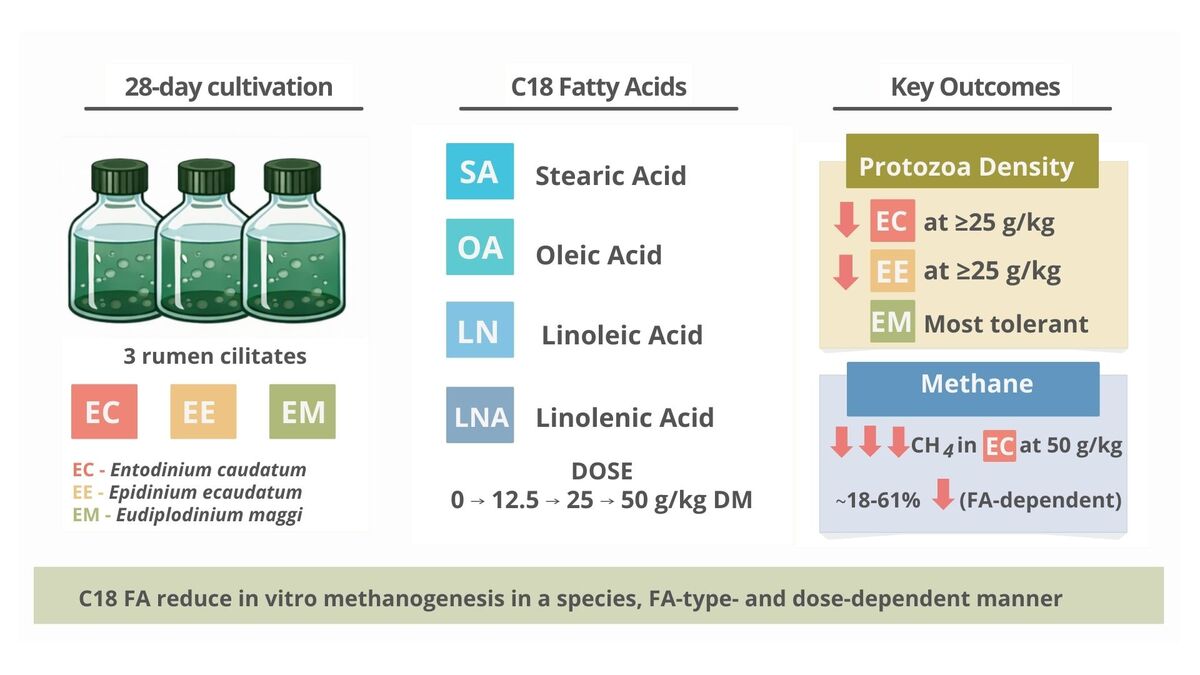
The study was carried out to investigate the long-term
(28 days) effects of different types and concentrations of C18 fatty acids
(FA) on methanogenesis, fermentation, and microbial population in cultures
of Entodinium caudatum (EC), Eudiplodinium maggii (EM), and Epidinium
ecaudatum (EE). The ciliates were maintained in vitro on a basal ‘caudatum’
type culture medium, supplemented with a substrate mixture consisting of
powdered meadow hay, wheat gluten (Sigma), crystalline cellulose (Sigmacell
20), and barley flour, together with an undefined prokaryotic population. Control
cultures were maintained on the basal medium, whereas experimental ones
were supplemented with stearic acid (SA), oleic acid (OA), linoleic acid (LN),
and linolenic acid (LNA) at concentrations of 1, 5, 25, and 50 g/kg substrate
mixture. After long-term cultivation, the following parameters were measured:
pH, ammonia, short chain fatty acids (SCFA), methane concentration, and
protozoal counts. Ciliates were enumerated under a light microscope, and
methane level was determined by gas chromatography. Responses to fatty acids
were species- and dose-dependent: EM was the most tolerant, whereas higher
supplementation levels (≥25 g/kg) generally reduced protozoal density in EC
and EE, with signs of gradual adaptation during long-term cultivation. Methane
concentration decreased most markedly in EC at 50 g/kg, with reductions
ranging from approx. 18 to 61% depending on the fatty acid. In EE, decreases
occurred mainly under stearic acid supplementation and selected unsaturated
fatty acid treatments, whereas total SCFA, pH and ammonia remained largely
unchanged. Overall, C18 fatty acids can reduce in vitro methanogenesis, but the
magnitude of the effect depends on protozoan species, fatty-acid type and dose.
CONFLICT OF INTEREST
The Authors declare that there is no conflict
of interest.
REFERENCES (32)
1.
Angelidaki I., Alves M., Bolzonella D., Borzacconi L., Campos J.L., Guwy A.J., Kalyuzhnyi S., Jenicek P., van Lier J.B., 2009. Defining the biomethane potential (BMP) of solid organic wastes and energy crops: a proposed protocol for batch assays. Water Sci. Technol. 59, 927–934, https://doi.org/10.2166/wst.20...
2.
AOAC International, 2005. Official Methods of Analysis of AOAC International, 18th Edition. AOAC International. Arlington, VA (USA)
3.
Cieślak A., Szumacher-Strabel M., Stochmal A., Oleszek W., 2013. Plant components with specific activities against rumen methanogens. Animal 7, 253–265, https://doi.org/10.1017/S17517...
4.
Cieślak A., Varadyova Z., Kišidayová S., Szumacher-Strabel M., 2009a. The effects of linoleic acid on the fermentation parameters, population density, and fatty-acid profile of two rumen ciliate cultures, Entodinium caudatum and Diploplastron affine. Acta Protozoologica 48, 51–61
5.
Cieślak A., Machmüller A., Szumacher-Strabel M., Scheeder M., 2009b. A note on comparison of two extraction methods used to quantify C18 fatty acids in feed and digesta of ruminants. J. Anim. Feed Sci. 18, 362–367, https://doi.org/10.22358/jafs/...
6.
Cieślak A., Miltko R., Bełżecki G., Szumacher-Strabel M., Michałowski T., 2009c. Rumen ciliates Entodinium caudatum, Eudiplodinium maggii and Diploplastron affine: a potential reservoir of unsaturated fatty acids for the host. Acta Protozoologica 48, 335–340
7.
Cieślak A., Miltko R., Bełżecki G., Szumacher-Strabel M., Potkański A., Kwiatkowska E., Michałowski T., 2006. Effect of vegetable oils on the methane concentration and population density of the rumen ciliate, Eremoplastron dilobum, grown in vitro. J. Anim. Feed Sci. 15, 15–18, https://doi.org/10.22358/jafs/...
8.
Coleman G.S., Davies J.I., Cash M.A., 1972. The cultivation of the rumen ciliates Epidinium ecaudatum caudatum and Polyplastron multivesiculatum in vitro. Microbiology 73, 509–521, https://doi.org/10.1099/002212...
9.
Czauderna M., Kowalczyk J., Niedźwiedzka K., Mieczkowska A., 2008. Efficient procedure for pre-column derivatization of fatty acids with emphasis on short-chain carboxylic acids. Chem. Anal. (Warsaw) 53, 535–544
10.
Czerkawski J., Harfoot C., Breckenridge G., 1972. The relationship between methane production and concentrations of hydrogen in the aqueous and gaseous phases during rumen fermentation in vitro. J. Appl. Bacteriol. 35, 537–551, https://doi.org/10.1111/j.1365...
11.
Eugène M., Massé D., Chiquette J., Benchaar C., 2008. Meta-analysis on the effects of lipid supplementation on methane production in lactating dairy cows. Canadian J. Anim. Sci. 88, 331–337, https://doi.org/10.4141/CJAS07...
12.
Foissner W., 1996. Ontogenesis in ciliated protozoa, with emphasis on stomatogenesis. In: K. Hausmann, P.C. Bradbury (Editors). Ciliates: Cells as Organisms. Gustav Fischer Verlag. Stuttgart (Germany), pp. 95–177
13.
Hegarty R., 1999. Reducing rumen methane emissions through elimination of rumen protozoa. Australian J. Agric. Res. 50, 1321–1328, https://doi.org/10.1071/AR9900...
14.
Henderson C., 1973. The effects of fatty acids on pure cultures of rumen bacteria. J. Agric. Sci. 81, 107–112, https://doi.org/10.1017/S00218...
15.
Hristov A., Ivan M., McAllister T., 2004. In vitro effects of individual fatty acids on protozoal numbers and on fermentation products in ruminal fluid from cattle fed a high-concentrate, barley-based diet. J. Anim. Sci. 82, 2693–2704, https://doi.org/10.2527/2004.8...
16.
Ivan M., Mir P., Koenig K., Rode L., Neill L., Entz T., Mir Z., 2001. Effects of dietary sunflower seed oil on rumen protozoa population and tissue concentration of conjugated linoleic acid in sheep. Small Rumin. Res. 41, 215–227, https://doi.org/10.1016/S0921-...
17.
Kišidayová S., Mihaliková K., Váradyová Z., Potkański A., Szumacher-Strabel M., Cieślak A., Čertik M., Jalč D., 2006. The effect of microbial oil, evening primrose oil,and borage oil on rumen ciliate populations in anartificial rumen (Rusitec). J. Anim. Feed Sci. 15, 153–156, https://doi.org/10.22358/jafs/...
18.
Kišidayová S., Váradyová Z., Michałowski T., Newbold C.J., 2005. Regeneration of cryoresistance of in vitro rumen ciliate cultures. Cryobiology 51, 76–84, https://doi.org/10.1016/j.cryo...
19.
Machmüller A., Soliva C.R., Kreuzer M., 2003. Effect of coconut oil and defaunation treatment on methanogenesis in sheep. Reprod. Nutr. Development 43, 41–55, https://doi.org/10.1051/rnd:20...
20.
McAllister T.A., Newbold C.J., 2008. Redirecting rumen fermentation to reduce methanogenesis. Australian J. Experimental Agric. 48, 7–13, https://doi.org/10.1071/EA0721...
21.
Michałowski T., 1987. The volatile fatty acids production by ciliate protozoa in the rumen of sheep. Acta Protozoologica. 26, 335–345
22.
Michałowski T., Szczepkowski P., Muszyński P., 1986. The nutritive factors affecting the growth of the rumen ciliate Diploplastron affine in vitro. Acta Protozoologica 25, 419–426
23.
Moss A.R., Jouany J.P., Newbold J., 2000. Methane production by ruminants: its contribution to global warming. Ann. Zootech. 49, 231–253, https://doi.org/10.1051/animre...
24.
Quinn G.P., Keough M.J., 2002. Experimental design and data analysis for biologists. Cambridge University Press. Cambridge (UK).
25.
Saxena S., Sehgal J., Puniya A.K., Singh K., 2010. Effect of administration of rumen fungi on production performance of lactating buffaloes. Beneficial Microbes 1, 183–188, https://doi.org/10.3920/BM2009...
26.
Small D.M., Cabral D.J., Cistola D.P., Parks J.S., Hamilton J.A., 1984. The ionization behavior of fatty acids and bile acids in micelles and membranes. Hepatology 4, 77S–79S, https://doi.org/10.1002/hep.18...
27.
Szumacher-Strabel M., Martin S., Potkański A., Cieślak A., Kowalczyk J., 2004. Changes in fermentation processes as the effect of vegetable oil supplementation in in vitro studies. J. Anim. Feed Sci. 13, 215–218, https://doi.org/10.22358/jafs/...
28.
Van Soest P.J., Robertson J.B., Lewis B.A., 1991. Methods for dietary fiber, neutral detergent fiber, and nonstarch polysaccharides in relation to animal nutrition. J. Dairy Sci. 74, 3583–3597, https://doi.org/10.3168/jds.S0...
29.
Vogels G.D., Hoppe W.F., Stumm C.K., 1980. Association of methanogenic bacteria with rumen ciliates. Appl. Env. Microbiol. 40, 608–612, https://doi.org/10.1128/aem.40...
30.
Williams A.G., Coleman G.S., 1997. The rumen protozoa. In: P.N. Hobson, C.S. Stewart. (Editors), The Rumen Microbial Ecosystem. Springer. Dordrecht (The Netherlands), pp. 73–139
31.
Williams A.G., Coleman G.S., 1992. Role of protozoa in the rumen. In: G.S. Coleman, A.G. Williams (Editors). The Rumen Protozoa. Springer. New York (USA), pp. 317–347, https://doi.org/10.1007/978-1-...
32.
Zhang C., Guo Y., Yuan Z., Wu Y., Wang J., Liu J., Zhu W., 2008. Effect of octadeca carbon fatty acids on microbial fermentation, methanogenesis and microbial flora in vitro. Anim. Feed Sci. Technol. 146, 259–269, https://doi.org/10.1016/j.anif...
Share
RELATED ARTICLE
| ISSN: | 1230-1388 |

Assigning DOI numbers, introducing articles from supplements and recent publications to POL-index database, maintaining anti-plagiarism detection, electronic system to proceed manuscripts and webpage of the Journal with interactive pdf files, and language correction of manuscripts published in Journal of Animal and Feed Sciences are financed in the years 2018–2019 by the Ministry of Science and Higher Education from the funds for science popularization activities, Agreement No. 631/P-DUN/2018.

© 2006-2026 Journal hosting platform by Bentus
We process personal data collected when visiting the website. The function of obtaining information about users and their behavior is carried out by voluntarily entered information in forms and saving cookies in end devices. Data, including cookies, are used to provide services, improve the user experience and to analyze the traffic in accordance with the Privacy policy. Data are also collected and processed by Google Analytics tool (more).
You can change cookies settings in your browser. Restricted use of cookies in the browser configuration may affect some functionalities of the website.
You can change cookies settings in your browser. Restricted use of cookies in the browser configuration may affect some functionalities of the website.