Current issue
Online first
Archive
About the Journal
Editorial Office
Editorial Board
Copy right and self-archiving policy
Peer review process
Instructions for Reviewers
Printed version subscription
Abstracting and indexing
Contact
Instructions for Authors
Policies
General information
Open Access, Licensing terms, Commercial use and Copyright terms policies
Self-archiving policy and Archive policies
Article Correction and Withdrawal policy
Manuscript Submission policy
Authorship policy
Conflict of Interest policy
Language considerations policy
Plagiarism and Duplicate publications policy
Ethics policy
Review process policy
Acceptance of manuscripts policy
Online First Articles and Special Issues policies
Generative artificial intelligence (AI) policy
Advertising policy
Article publication charges
Policies
General information
Open Access, Licensing terms, Commercial use and Copyright terms policies
Self-archiving policy and Archive policies
Article Correction and Withdrawal policy
Manuscript Submission policy
Authorship policy
Conflict of Interest policy
Language considerations policy
Plagiarism and Duplicate publications policy
Ethics policy
Review process policy
Acceptance of manuscripts policy
Online First Articles and Special Issues policies
Generative artificial intelligence (AI) policy
Advertising policy


ORIGINAL PAPER
Effects of different additives on nutritional quality and fermentation characteristics of industrial hemp silage
1
Erciyes University, Faculty of Veterinary Medicine, Department of Animal Nutrition and Nutritional Diseases, 38280 Kayseri, Türkiye
These authors had equal contribution to this work
Publication date: 2026-05-20
Corresponding author
E. KUM
Erciyes University, Faculty of Veterinary Medicine, Department of Animal Nutrition and Nutritional Diseases, 38280 Kayseri, Türkiye
Erciyes University, Faculty of Veterinary Medicine, Department of Animal Nutrition and Nutritional Diseases, 38280 Kayseri, Türkiye
J. Anim. Feed Sci. 2026;35(3):e37
KEYWORDS
TOPICS
ABSTRACT
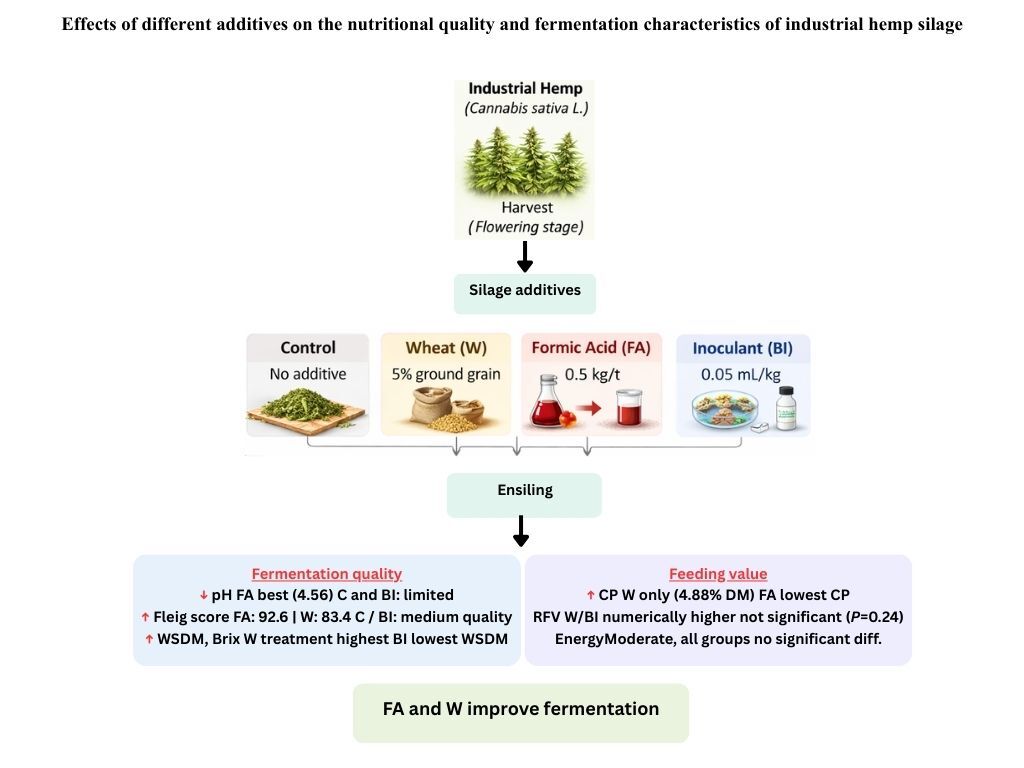
This study aimed to evaluate the effects of ground wheat grain, formic acid and a bacterial inoculant on fermentation quality, chemical composition and estimated feeding value of hemp silage. Industrial hemp (Cannabis sativa L.) was harvested at the full-flowering stage, chopped to 1–2 cm fragments and ensiled using four treatments: control (no additive), 5% ground wheat grain, 0.5 kg/t formic acid and 0.05 ml/kg bacterial inoculant, each prepared in triplicate. Fresh hemp showed high concentrations of neutral detergent fibre (79.46%), acid detergent fibre (65.48%) and acid detergent lignin (11.55%), together with low crude protein (3.41%) and water-soluble dry matter, indicating limited fermentability. Additives significantly influenced silage pH and Fleig scores (P < 0.001). Formic acid addition resulted in the most favourable fermentation profile, with the lowest pH (4.56) and highest Fleig score (92.64). Ground wheat increased water-soluble dry matter, Brix values, and crude protein content (4.88%) and improved silage quality. In contrast, bacterial inoculant caused only a minor decrease in pH, likely due to the low sugar content and high buffering capacity of hemp forage. Energy-related parameters, including total digestible nutrients, metabolizable energy and net energy fractions, were not significantly affected by additives, likely due to the fibrous and lignified structure of hemp. However, the improvement in relative feed value caused by wheat grain addition indicates that carbohydrate supplementation can partially improve feeding value of hemp silage. Overall, industrial hemp is a low-protein, high-fibre forage with limited fermentability, although formic acid and carbohydrate-based additives can improve its fermentation characteristics.
ACKNOWLEDGEMENTS
The authors would like to thank the General
Directorate of Agricultural Research and Policies
(TAGEM), Middle Black Sea Transitional Zone Agricultural Research Institute (Tokat, Türkiye) for providing plant material and technical support, as well
as the Erciyes University Scientific Research Projects
(BAP) Coordination Unit for financial assistance.
CONFLICT OF INTEREST
The Authors declare that there is no conflict of
interest.
REFERENCES (27)
1.
Andre C.M., Hausman J.F., Guerriero G., 2016. Cannabis sativa: The plant of the thousand and one molecules. Front. Plant Sci. 7, 19–31, https://doi.org/10.3389/fpls.2....
2.
AOAC, 1990. Official Methods of Analysis. 15th Ed. Association of Official Analytical Chemists. Arlington, VA (USA)
3.
Bailoni L., Bacchin E., Trocino A., Arango S., 2021. Hemp seed and co-products inclusion in ruminant diets: A review. Animals 11(3), 856, https://doi.org/10.3390/ani110....
4.
Callaway J.C., 2004. Hempseed as a nutritional resource: An overview. Euphytica 140, 65–72, https://doi.org/10.1007/s10681....
5.
DLG (Deutsche Landwirtschafts-Gesellschaft e.V.), 1997. Feed Value Tables for Ruminants: 7th Expanded and Revised Edition (in German). DLG-Verlag. Frankfurt am Main (Germany)
6.
EFSA FEEDAP (EFSA Panel on Additives and Products or Substances used in Animal Feed), 2011. Scientific opinion on the safety of hemp (Cannabis genus) for use as animal feed. EFSA J. 9, 2011–2141, https://doi.org/10.2903/j.efsa...
7.
EFSA CONTAM (EFSA Panel on Contaminants in the Food Chain), 2015. Scientific opinion on the risks for animal and human health related to the presence of tetrahydrocannabinol (THC) in milk and other food of animal origin. EFSA J. 13, 4141, https://doi.org/10.2903/j.efsa...
8.
Filya I., 2003. The effect of Lactobacillus buchneri and Lactobacillus plantarum on the fermentation, aerobic stability, and ruminal degradability of low dry matter corn and sorghum silages. J. Dairy Sci. 86, 3575–3581, https://doi.org/10.3168/jds.S0....
9.
Güney M., Bingöl N.T., Aksu T., 2016. Relative feed value (RFV) and relative forage quality index (RFQI) used in classification of forage quality (in Turkish). Atatürk Univ. Vet. Bil. Derg. 11, https://doi.org/10.17094/avbd.....
10.
Gürbüz Y., İbrahim E.S., Sezmis G., 2022. Usability of cannabis plant by-products as an alternative feed source in animal nutrition (in Turkish). Bozok J. Agri. Nat. Sci. 1, 62-70, https://izlik.org/JA27TB85NM
11.
Irawan A., Buffington H., Ates S., Bionaz M., 2025. Use of industrial hemp byproducts in ruminants: a review of the nutritional profile, animal response, constraints, and global regulatory environment. J. Cannabis Res. 7, 25, https://doi.org/10.1186/s42238....
12.
Jeranyama P., Garcia A.D., 2004. Understanding relative feed value (RFV) and relative forage quality (RFQ). Extension Extra, Paper 352. South Dakota State University. Brookings, SD (USA).
13.
Klevenhusen F., These A., Weiß K., Gusovius H.J., Pieper R., 2024. Ensiling conditions and changes of cannabinoid concentration in industrial hemp. Arch. Anim. Nutr. 78, 242–253, https://doi.org/10.1080/174503....
14.
Klir Ž., Novoselec J., Antunović Z., 2019. An overview on the use of hemp (Cannabis sativa L.) in animal nutrition. Poljoprivreda 25, 52–61, http://dx.doi.org/10.18047/pol....
15.
Kung L. Jr., Shaver R.D., 2001. Interpretation and use of silage fermentation analysis reports. Focus Forage 3, 1–5, University of Wisconsin Extension. Madison, WI (USA)
16.
Meeske R., 2005. Silage additives: Do they make a difference? S. Afr. J. Anim. Sci. 6, 49–55
17.
Muedi H.T.H., Kujoana T.C., Shai K., Mabelebele M., Sebola N.A., 2024. The use of industrial hemp (Cannabis sativa) on farm animal's productivity, health and reproductive performance: a review. Anim. Prod. Sci. 64, https://doi.org/10.1071/AN2326....
18.
Mustafa A.F., McKinnon J.J., Christensen D.A., 1999. The nutritive value of hemp meal for ruminants. Can. J. Anim. Sci. 79, 91–95, https://doi.org/10.4141/A98-03....
19.
NRC (National Research Council), 2001. Nutrient Requirements of Dairy Cattle. 7th Rev. Ed. National Academies Press. Washington, DC (USA)
20.
Rohweder D.A., Barnes R.F., Jorgensen N., 1978. Proposed hay grading standards based on laboratory analyses for evaluating quality. J. Anim. Sci. 47, 747–759, https://doi.org/10.2527/jas197....
21.
Shah M.H., Ayaz Chishti M.F., Anwar U. et al., 2024. Evaluation of chemical composition and in-situ digestion kinetics of industrial hemp silage and hay. Pak. J. Agric. Sci. 61, 941–946
22.
Struik P.C., Amaducci S., Bullard M.J., Stutterheim N.C., Venturi G., Cromack H.T.H., 2000. Agronomy of fibre hemp (Cannabis sativa L.) in Europe. Ind. Crops Prod. 11(2–3), 107–118, https://doi.org/10.1016/S0926-....
23.
UNODC (United Nations Office on Drugs and Crime), 2009. Recommended Methods for the Identification and Analysis of Cannabis and Cannabis Products. United Nations. New York, NY (USA)
24.
Van Soest P.J., Robertson J.B., Lewis B.A., 1991. Methods for dietary fiber, neutral detergent fiber, and nonstarch polysaccharides in relation to animal nutrition. J. Dairy Sci. 74, 3583–3597, https://doi.org/10.3168/jds.S0....
25.
Weiss, W.P., 1994. Estimation of Digestibility of Forages by Laboratory Methods. In: Forage Quality, Evaluation, and Utilization, G.C. Fahey (Ed.). https://doi.org/10.2134/1994.f....
26.
Wróbel B., Hryniewicz M., Kulkova I. et al., 2023. Fermentation quality and chemical composition of industrial hemp (Cannabis sativa L.) silage inoculated with bacterial starter cultures – A pilot study. Agronomy 13, 1371, https://doi.org/10.3390/agrono....
27.
Zicarelli F., Lotito D., Iommelli P. et al., 2025. Hemp hay (Cannabis sativa L.) in grazing goats' diet: Effects on oxidative and inflammatory status. Animals 15, 364, https://doi.org/10.3390/ani150....
Share
RELATED ARTICLE
| ISSN: | 1230-1388 |

Assigning DOI numbers, introducing articles from supplements and recent publications to POL-index database, maintaining anti-plagiarism detection, electronic system to proceed manuscripts and webpage of the Journal with interactive pdf files, and language correction of manuscripts published in Journal of Animal and Feed Sciences are financed in the years 2018–2019 by the Ministry of Science and Higher Education from the funds for science popularization activities, Agreement No. 631/P-DUN/2018.

© 2006-2026 Journal hosting platform by Bentus
We process personal data collected when visiting the website. The function of obtaining information about users and their behavior is carried out by voluntarily entered information in forms and saving cookies in end devices. Data, including cookies, are used to provide services, improve the user experience and to analyze the traffic in accordance with the Privacy policy. Data are also collected and processed by Google Analytics tool (more).
You can change cookies settings in your browser. Restricted use of cookies in the browser configuration may affect some functionalities of the website.
You can change cookies settings in your browser. Restricted use of cookies in the browser configuration may affect some functionalities of the website.