Current issue
Online first
Archive
About the Journal
Editorial Office
Editorial Board
Copy right and self-archiving policy
Peer review process
Instructions for Reviewers
Printed version subscription
Abstracting and indexing
Contact
Instructions for Authors
Policies
General information
Open Access, Licensing terms, Commercial use and Copyright terms policies
Self-archiving policy and Archive policies
Article Correction and Withdrawal policy
Manuscript Submission policy
Authorship policy
Conflict of Interest policy
Language considerations policy
Plagiarism and Duplicate publications policy
Ethics policy
Review process policy
Acceptance of manuscripts policy
Online First Articles and Special Issues policies
Generative artificial intelligence (AI) policy
Advertising policy
Article publication charges
Policies
General information
Open Access, Licensing terms, Commercial use and Copyright terms policies
Self-archiving policy and Archive policies
Article Correction and Withdrawal policy
Manuscript Submission policy
Authorship policy
Conflict of Interest policy
Language considerations policy
Plagiarism and Duplicate publications policy
Ethics policy
Review process policy
Acceptance of manuscripts policy
Online First Articles and Special Issues policies
Generative artificial intelligence (AI) policy
Advertising policy

ORIGINAL PAPER
Comparative studies on performance and meat texture traits in Pekin duck genetic resources and commercial hybrids

1
Department of Poultry Breeding, National Research Institute of Animal Production,
32-083 Balice n. Kraków, Poland
2
National Research Institute of Animal Production,
32-083 Balice n. Kraków, Poland
Publication date: 2026-06-24
Corresponding author
L. Lewko
Department of Poultry Breeding, National Research Institute of Animal Production, 32-083 Balice n. Kraków, Poland
Department of Poultry Breeding, National Research Institute of Animal Production, 32-083 Balice n. Kraków, Poland
KEYWORDS
TOPICS
ABSTRACT
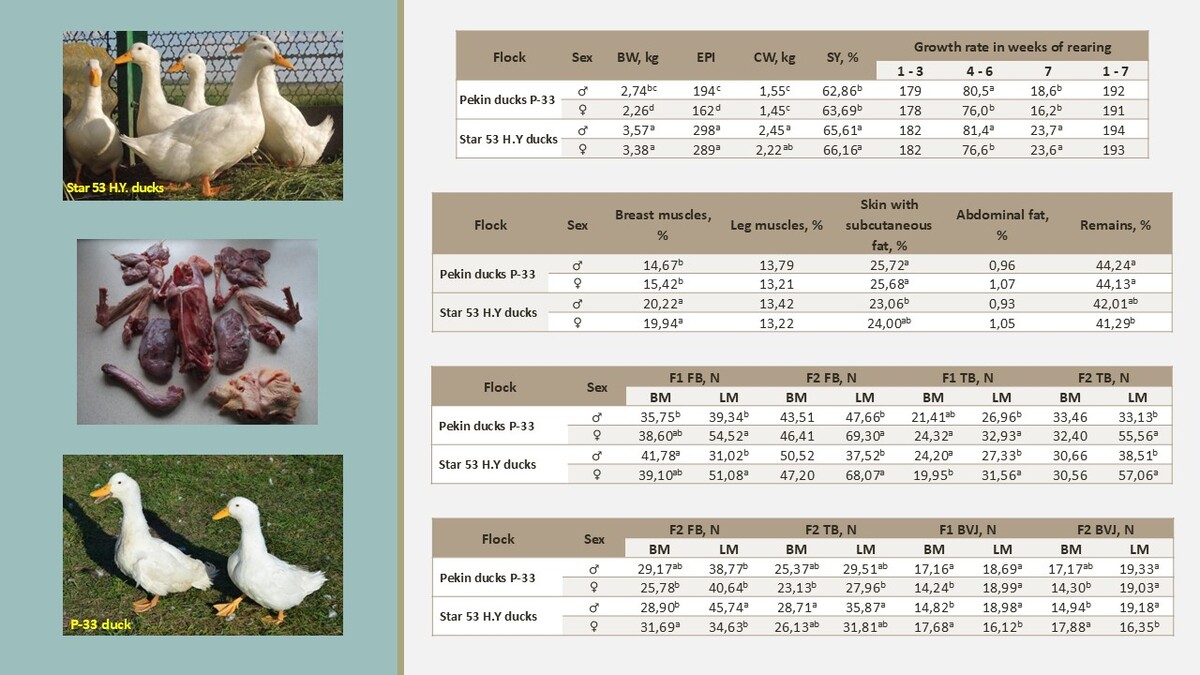
The aim of the study was to determine and compare basic performance and slaughter traits, as well as meat texture in Pekin ducks from two genetic groups: Star 53 H.Y. (commercial hybrid, Grimaud Frères, France) and P-33 (Polish Pekin, domestic genetic resource), with consideration of bird sex. The experimental material consisted of 160 Pekin ducks, divided into two groups (80 birds each) according to genetic origin: A – Polish Pekin P-33 and B – Star 53 H.Y. The results showed more favourable (P ≤ 0.05) performance trait values in the commercial group compared to the genetic resource group of Pekin ducks, including growth rate in the last (7th) week of rearing, final body weight, slaughter yield, carcass weight, proportion of breast muscle, skin with subcutaneous fat in the carcass, and remainders (neck, wings, skeleton). Analysis of meat texture indicated significant differences (P ≤ 0.05) between the two flocks only after heat treatment: meat from the conservation group was more tender in both blade shear tests.
CONFLICT OF INTEREST
The Authors declare that there is no conflict of interest.
REFERENCES (42)
1.
Adamski M., Bernacki Z., Kuźniacka J., 2005. The effects of origin and sex on rearing results of ducks from two ancestral paternal strains (in Polish). Acta Sci. Pol. Zootech. 4, 13–28.
2.
Augustyńska-Prejsnar A., Sokołowicz Z., 2014. Czynniki kształtujące jakość sensoryczną mięsa kurcząt brojlerów (in Polish). Wiad. Zoot. LII 2, 108–116.
3.
Baéza E., 2006. Effects of genotype, age and nutrition on intramuscular lipids and meat quality. Symposium COA/INRA Scientific Cooperation in Agriculture. Tainan (Taiwan R.O.C.), pp. 79–82.
4.
Bernacki Z., Adamski M., Kuźniacka J., Kokoszyński D., 2006. Porównanie cech mięsnych kaczek rzeźnych o rożnym pochodzeniu do 9. tygodnia życia (in Polish). Rocz. Nauk. Zoot. 33, 41–57.
5.
Bernacki Z., Kokoszyński D., Mallek T., 2008. Evaluation of selected meat traits in seven-week-old duck broilers. Anim. Sci. Pap. Rep. 26, 165–174.
6.
Biesiada-Drzazga B., Grużewska A., Charuta A., Litwa M., Nasiłowska A., 2012. Badania nad wzrostem, budową ciała i wartością rzeźną kaczek Star 53 H.Y. (in Polish). Rocz. Nauk. Zoot. 39, 225–235.
7.
Biesiada-Drzazga B., Charuta A., Janocha A., Łęczycka J., 2011. Ocena wartości rzeźnej kaczek pekin Star 53 HY (in Polish). Rocz. Nauk. PTZ 7, 109–116.
8.
Diakun J., Dolik K., Seńcio M., Tomkiewicz D., 2012. Ocena tekstury mięsa z wykorzystaniem środowiska Matlab (in Polish). PAK 58, 480–483.
9.
Farhat A., 2009. Carcass characteristics of Pekin ducks selected for greater breast muscle thickness using ultrasound scanning in response to dietary protein. Res. J. Agric. & Biol. Sci. 5, 731–739.
10.
Farhat A., Normand L., Chavez E.R., Touchburn S.P., 2001. Comparison of growth performance, carcass yield and composition, and fatty acid profiles of Pekin and Muscovy ducklings fed diets based on food wastes. Can. J. Anim. Sci. 81, 107–114, https://doi.org/10.4141/A99-05....
11.
Fernandez X., Lahirigoyen E., Auvergne A., Molette C., Bouillier-Oudot M., 2010. The effect of stunning methods on product qualities in forcefed ducks and geese. 1. Carcass downgrading and meat quality. Animal 4, 128–138, https://doi.org/10.1017/S17517....
12.
Galić A., Filipović D., Plestić S., Janječić Z., Bedeković D., Kovačev I., Čopec K., Koronc Z., 2019. Comparison of quality characteristics of Pekin duck and Cherry Valley duck eggs from free-range raising system. J. Cent. Eur. Agric. 20, 1099–1110, https://doi.org/10.5513/JCEA01....
13.
Gerzilov V., Bozakova N., Bochukov A., Penchev G., Lyutskanov M., Popova-Ralcheva S., Sredkova V., 2011. Influence of the prebiotic Salgard and a herb mixture on Pekin ducklings in organic poultry production. I. Growth performance and blood biochemical parameters. Biotech. Anim. Husbandry 27, 33–43, https://doi.org/10.2298/BAH110....
14.
Ghazali R., Rahim H.A., Maidin M.S., Sahlan S., 2013. Low cost visible/near-infrared reflectance spectroscopy for raw poultry meat texture prediction. World Acad. Sci. Eng. Technol. 77, 471–476.
15.
Gornowicz E., Lewko L., Szukalski G., Pietrzak M., 2009. Kształtowanie się cech rzeźnych i jakości mięsa kaczek stad zachowawczych (in Polish). Rocz. Inst. Przem. Mięsn. Tłuszcz. T.XLVII/ 2, 106–115.
16.
Graczyk M., Gornowicz E., Mucha S., Lisowski M., Grajewski B., Radziszewska J., Pietrzak M., Szwaczkowski T., 2016. Heritability of some meat quality traits in ducks. Rocz. Nauk. PTZ 12, 9–17, https://doi.org/10.5604/01.300....
17.
Honikel K.O., 1998. Reference methods for the assessment of physical characteristics of meat. Meat Sci. 49, 447–457, https://doi.org/10.1016/S0309-....
18.
Huang, J.F., Pingel H., Guy G., Lukaszewicz E., Baeza E., Wang S.D., 2012. A century of progress in waterfowl production, and a history of the WPSA Waterfowl Working Group. World’s Poult. Sci. J. 68, 551–563, https://doi.org/10.1017/S00439....
19.
Huda N., Putra A.A., Ahmad R., 2011. Proximate and physicochemical properties of Peking and Muscovy duck breasts and thighs for further processing. J. Food Agric. Environ. 1, 82–88.
20.
Jung Y., Zhou Y.P., 1980., The Pekin duck in China. World Animal Review 34, 11–14.
21.
Kisiel T., Książkiewicz J., 2004. Comparison of physical and qualitative traits of meat of two Polish conservative flocks of ducks. Arch. Anim. Breed. (Arch. Tierz.) 47, 367–375, https://doi.org/10.5194/aab-47....
22.
Kokoszyński D., Piwczyński D., Arpašova H., Hrnčar C., Saleh M., Wasilewski R., 2019. A comparative study of carcass characteristics and meat quality in genetic resources Pekin ducks and commercial crossbreds. Asian-Australas J. Anim. Sci. 32 , 1753–1762, https://doi.org/10.5713/ajas.1....
23.
Kokoszyński D., Wasilewski R., Stęczny K., Bernacki Z., Kaczmarek K., Saleh M., Wasilewski P.D., Biegniewska M., 2015. Comparison of growth performance and meat traits in Pekin ducks from different genotypes. Europ. Poult. Sci. 79, 1–11, https://doi.org/10.1399/eps.20....
24.
Kuźniacka J., Adamski M., 2019. Effect of genotype and age at slaughter on meat traits in Pekin ducks. Europ. Poult. Sci. 83, 1–10, https://doi.org/10.1399/eps.20....
25.
Lacin E., Aksu M.I., Macit M., Yildiz A., Karaoglu M., Esenbuga N., Yoruk M.A., 2008. Effects of different raising systems on colour and meat quality characteristics of Turkish pekin duck meats. S. Afr. J. Anim. Sci. 38, 217–223, https://doi.org/10.4314/sajas.....
26.
Lewko L., Gornowicz E., Kryza A., Adamski M., 2024. Development of selected performance, dressing and meat quality traits of Pekin ducks in relation to genotype and phytogenic feed additives. Anim. Sci. Pap. Rep. 42, 297–310, https://doi.org/10.2478/aspr-2....
27.
Makram A., Galal A., El-Attar A.H., 2017. Comparative study on phenotypic parameters of Sudani, Muscovy and Pekin ducks in Egypt. Proceedings 7th International Conference of Sustainable Agricultural Development Fayoum (Egypt), pp. 257–268.
28.
Mazanowski A., Kisiel T., Gornowicz E., 2003. Carcass quality, meat traits and chemical composition of meat in ducks of paternal strains A44 and A55. Anim. Sci. Pap. Rep. 21, 251–263.
29.
Mucha S., Gornowicz E., Lisowski M., Grajewski B., Radziszewska J., Szwaczkowski T., 2014. Genetic parameters of carcass traits in ducks from a crossbred population. Ann. Anim. Sci. 14, 43–53, https://doi.org/10.2478/aoas-2....
30.
Muhlisin M., Kim D.S., Song Y.R., Kim H.R., Kwon H.J., An B.K., Kang C.W., Kim H.K., Lee S.K., 2013. Comparison of meat characteristics between Korean native duck and imported commercial duck raised under identical rearing and feeding condition. Korean J. Food Sci. An. Resour. 33, 89–95, http://doi.org/10.5851/kosfa.2....
31.
Omojola A.B., 2007. Carcass and organoleptic characteristics of duck meat as influenced by breed and sex. Int. J. Poult. Sci. 6, 329–334, https://doi.org/10.3923/ijps.2....
32.
Onk K., Yalcintan H., Sari M., Isik S.A., Yakan A., Ekiz B., 2019. Effects of genotype and sex on technological properties and fatty acid composition of duck meat. Poult. Sci. 98, 491–499, https://doi.org/10.3382/ps/pey....
33.
Pingel H., 2011. Results of selection for breast muscle percentage and feed conversion ratio in pekin ducks. Biotechnol. Anim. Husb. 27, 769–776, https://doi.org/10.2298/BAH110....
34.
Smith D.P., Northcutt J.K., Qudsieh R.I., Parisi M.A., 2015. Effect of strain on duck breast meat quality. J. Appl. Poult. Res. 24, 401–407, https://doi.org/10.3382/japr/p....
35.
Solomon J.K.Q., Austin R., Cumberbatch R.N., Gonsalves J., Seaforth E., 2006. A comparison of live weight and carcass gain of Pekin, Kunshan and Muscovy ducks on a commercial ration. Livest. Res. Rural Develop. 18, http://www.cipav.org.co/lrrd/l....
36.
StatSoft, 2006. Elektroniczny podręcznik statystyki (in Polish). Kraków (Poland), http://www.statsoft.pl/textboo....
37.
Stęczny K., Kuźniacka J., Adamski M., 2015. Comparison of growth rate and body weight of ducks of different origins. Acta Sci. Pol.. Zootechnica 14, 97–106.
38.
Wawro K., Wilkiewicz-Wawro E., Kleczek K., Brzozowski W., 2004. Slaughter value and meat quality of Muscovy ducks. Pekin ducks and their crossbreeds, and evaluation of the heterosis effect. Arch. Anim. Breed. (Arch. Tierz.) 47, 287–299, https://doi.org/10.5194/aab-47....
39.
Witak B., 2008. Tissue composition of carcass, meat quality and fatty acid content of ducks of a commercial breeding line at different age. Arch. Anim. Breed. (Arch. Tierz.) 51, 266–275, https://doi.org/10.5194/aab-51....
40.
Witkiewicz K., Kontecka H., Książkiewicz J., 2006. Basic elements of eviscerated carcass and chemical composition of pectoral muscle in selected and unselected ducks. Arch. Anim. Breed. (Arch. Tierz.) 49, 502–507, https://doi.org/10.5194/aab-49....
41.
Wołoszyn J., Okruszek A., Orkusz A., Wereńska M., Książkiewicz J., Grajeta H., 2011. Effect of duck genotype on leg muscle properties. Arch. Anim. Breed. (Arch. Tierz.) 54, 649–660, https://doi.org/10.5194/aab-54....
42.
Ziołecki J., Doruchowski W., 1989. Metoda oceny wartości rzeźnej drobiu (in Polish). COBRD. Zakrzewo (Polska), p. 32.
Share
RELATED ARTICLE
| ISSN: | 1230-1388 |

Assigning DOI numbers, introducing articles from supplements and recent publications to POL-index database, maintaining anti-plagiarism detection, electronic system to proceed manuscripts and webpage of the Journal with interactive pdf files, and language correction of manuscripts published in Journal of Animal and Feed Sciences are financed in the years 2018–2019 by the Ministry of Science and Higher Education from the funds for science popularization activities, Agreement No. 631/P-DUN/2018.

© 2006-2026 Journal hosting platform by Bentus
We process personal data collected when visiting the website. The function of obtaining information about users and their behavior is carried out by voluntarily entered information in forms and saving cookies in end devices. Data, including cookies, are used to provide services, improve the user experience and to analyze the traffic in accordance with the Privacy policy. Data are also collected and processed by Google Analytics tool (more).
You can change cookies settings in your browser. Restricted use of cookies in the browser configuration may affect some functionalities of the website.
You can change cookies settings in your browser. Restricted use of cookies in the browser configuration may affect some functionalities of the website.