Current issue
Online first
Archive
About the Journal
Editorial Office
Editorial Board
Copy right and self-archiving policy
Peer review process
Instructions for Reviewers
Printed version subscription
Abstracting and indexing
Contact
Instructions for Authors
Policies
General information
Open Access, Licensing terms, Commercial use and Copyright terms policies
Self-archiving policy and Archive policies
Article Correction and Withdrawal policy
Manuscript Submission policy
Authorship policy
Conflict of Interest policy
Language considerations policy
Plagiarism and Duplicate publications policy
Ethics policy
Review process policy
Acceptance of manuscripts policy
Online First Articles and Special Issues policies
Generative artificial intelligence (AI) policy
Advertising policy
Article publication charges
Policies
General information
Open Access, Licensing terms, Commercial use and Copyright terms policies
Self-archiving policy and Archive policies
Article Correction and Withdrawal policy
Manuscript Submission policy
Authorship policy
Conflict of Interest policy
Language considerations policy
Plagiarism and Duplicate publications policy
Ethics policy
Review process policy
Acceptance of manuscripts policy
Online First Articles and Special Issues policies
Generative artificial intelligence (AI) policy
Advertising policy

ORIGINAL PAPER
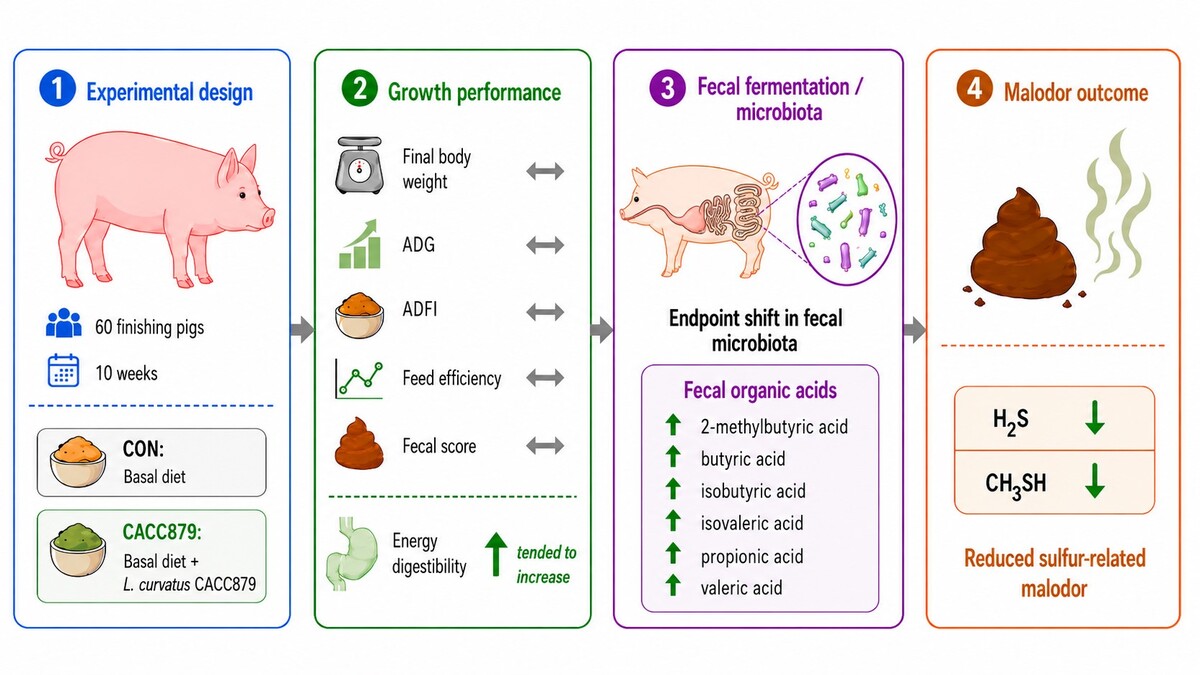
Effects of dietary supplementation with Latilactobacillus curvatus CACC879 on faecal organic acid profiles and sulphur-related malodour reduction with maintained growth performance in finishing pigs
1
Center for Industrialization of Agricultural and Livestock Microorganisms, Department of Research and Development, 56212 Jeongeup-si, Republic of Korea
2
Jeonbuk National University, Department of Animal Biotechnology, 54896 Jeonju-si, Republic of Korea
These authors had equal contribution to this work
Publication date: 2026-10-07
Corresponding author
Y. Kim
Department of Research and Development, Center for Industrialization of Agricultural and Livestock Microorganisms
Department of Research and Development, Center for Industrialization of Agricultural and Livestock Microorganisms
KEYWORDS
TOPICS
ABSTRACT
This study evaluated the effects of dietary supplementation with Latilactobacillus curvatus CACC879 on growth performance, nutrient digestibility, faecal microbiota, faecal organic acid profiles, and malodour compounds in faecal slurry from finishing pigs. Sixty finishing pigs [(Landrace × Yorkshire) × Duroc; 30 males and 30 females; initial body weight, 54.98 ± 3.38 kg] were randomly assigned to one of two dietary treatments for 10 weeks: a basal diet (CON) or the basal diet supplemented with 0.25% L. curvatus CACC879 (1.2 × 10¹⁰ CFU/g; CACC879). Growth performance, nutrient digestibility, and faecal score were evaluated. Faecal samples collected from a subset of pigs on day 0 (D0) and day 70 (D70) were subjected to 16S rRNA gene sequencing and organic acid analysis. Hydrogen sulphide and methyl mercaptan concentrations in faecal slurry were measured using standard methods for offensive odour compounds. Dietary supplementation with L. curvatus CACC879 did not affect final body weight, average daily gain, average daily feed intake, feed efficiency, or faecal score, although energy digestibility tended to increase. On D70, CACC879 supplementation was associated with altered faecal microbial community structure and nominal differences in selected bacterial genera. In addition, the CACC879 group showed higher concentrations of selected faecal organic acids, including 2 methylbutyric, butyric, isobutyric, isovaleric, propionic, and valeric acids, while hydrogen sulphide and methyl mercaptan concentrations were reduced. These findings suggest that L. curvatus CACC879 may be a promising microbial feed additive for modifying faecal fermentation profiles and reducing sulphur-related odour compounds in finishing pigs without impairing growth performance.
FUNDING
This work was supported by the INNOPOLIS FOUNDATION through the Science and Technology Project Opens the Future of the Region, funded by the Ministry of Science and ICT (Project No. 1711177233); the Innopolis Foundation through the 2025 Local Innovation Engine Project (2025 Jeonbuk Advanced Bio Boost-UP Platform Project), funded by the Ministry of Science and ICT (Project No. 2710085200); and the Korea Institute of Planning and Evaluation for Technology in Food, Agriculture and Forestry (IPET) through the Agri-Food Export Enhancement Technology Development Program, funded by the Ministry of Agriculture, Food and Rural Affairs (MAFRA) (Project No. RS-2023-00234143).
CONFLICT OF INTEREST
The Authors declare that there is no conflict of interest.
REFERENCES (34)
1.
Andrews S., 2010. FastQC: a quality control tool for high throughput sequence data. Babraham Bioinformatics, Cambridge (UK).
2.
Barba-Vidal E., Martín-Orúe S.M., Castillejos L., 2019. Practical aspects of the use of probiotics in pig production: a review. Livest. Sci. 223, 84-96, https://doi.org/10.1016/j.livs....
3.
Bolyen E., Rideout J.R., Dillon M.R. et al., 2019. Reproducible, interactive, scalable and extensible microbiome data science using QIIME 2. Nat. Biotechnol. 37, 852-857, https://doi.org/10.1038/s41587....
4.
Callahan B.J., McMurdie P.J., Rosen M.J., Han A.W., Johnson A.J.A., Holmes S.P., 2016. DADA2: high-resolution sample inference from Illumina amplicon data. Nat. Methods 13, 581-583, https://doi.org/10.1038/nmeth.....
5.
Cao S., Muniyappan M., Shi H., Kim I.H., 2025. Dietary inclusion of Bacillus-based probiotic complex improved average daily weight gain and gain-to-feed ratio and reduced faecal noxious gas emission in weaned pigs. J. Anim. Feed Sci. 34, 200-208, https://doi.org/10.22358/jafs/....
6.
Cutting S.M., 2011. Bacillus probiotics. Food Microbiol. 28, 214-220, https://doi.org/10.1016/j.fm.2....
7.
Dai Q., Wu J., Chen F., Jiang G., 2025. Fecal steroids, short-chain fatty acids, and microbiota in high- versus low-yielding forest musk deer. AMB Express 15, 168, https://doi.org/10.1186/s13568....
8.
Douglas G.M., Maffei V.J., Zaneveld J.R. et al., 2020. PICRUSt2 for prediction of metagenome functions. Nat. Biotechnol. 38, 685-688, https://doi.org/10.1038/s41587....
9.
Dowarah R., Verma A.K., Agarwal N., 2017. The use of Lactobacillus as an alternative of antibiotic growth promoters in pigs: a review. Anim. Nutr. 3, 1-6, https://doi.org/10.1016/j.anin....
10.
European Commission, 2005. Ban on antibiotics as growth promoters in the European Union. Press release IP/05/1687, Brussels, 21 Dec 2005.
11.
European Parliament and Council, 2003. Regulation (EC) No 1831/2003 of the European Parliament and of the Council of 22 September 2003 on additives for use in animal nutrition. Off. J. Eur. Union L268, 29-43.
12.
FAO/WHO, 2002. Guidelines for the evaluation of probiotics in food. Report of a Joint FAO/WHO Working Group on Drafting Guidelines for the Evaluation of Probiotics in Food, London, Ontario, Canada, 30 April-1 May 2002.
13.
Guarrasi J., Trask C., Kirychuk S., 2015. A systematic review of occupational exposure to hydrogen sulfide in livestock operations. J. Agromedicine 20, 225-236, https://doi.org/10.1080/105992....
14.
Hossain M.M., Cho S.B., Kim I.H., 2024. Strategies for reducing noxious gas emissions in pig production: a comprehensive review on the role of feed additives. J. Anim. Sci. Technol. 66, 237-250, https://doi.org/10.5187/jast.2....
15.
Jo S.-H., Kim K.-H., Jeon B.-H., Lee M.-H., Kim Y.-H., Kim B.-W., Cho S.-B., Hwang O.-H., Bhattacharya S.S., 2015. Odor characterization from barns and slurry treatment facilities at a commercial swine facility in South Korea. Atmos. Environ. 119, 339-347, https://doi.org/10.1016/j.atmo....
16.
Jo Y.Y., Choi M.J., Chung W.L., Hong J.S., Lim J.S., Kim Y.Y., 2021. Effects of feed form and particle size on growth performance, nutrient digestibility, carcass characteristics, and gastric health in growing-finishing pigs. Anim. Biosci. 34, 1061-1069, https://doi.org/10.5713/ab.20.....
17.
Kim S.H., Vasquez R., Song J.H., Kang D.-K., 2026. Priestia megaterium reduces hydrogen sulfide level in swine manure potentially through an assimilatory mechanism and microbiota modulation. Appl. Microbiol. Biotechnol. 110, 28, https://doi.org/10.1007/s00253....
18.
Lan R.X., Lee S.I., Kim I.H., 2016. Effects of multistrain probiotics on growth performance, nutrient digestibility, blood profiles, faecal microbial shedding, faecal score and noxious gas emission in weaning pigs. J. Anim. Physiol. Anim. Nutr. 100, 1130-1138, https://doi.org/10.1111/jpn.12....
19.
Lee M.-D., 2007. Review of odor measurement and analysis method: Standard method of odor compounds (in Korean). J. Korean Soc. Environ. Eng. 29, 761-767.
20.
Lee W.J., Ryu S., Kang A.N., Song M., Shin M., Oh S., Kim Y., 2022. Molecular characterization of gut microbiome in weaning pigs supplemented with multi-strain probiotics using metagenomic, culturomic, and metabolomic approaches. Anim. Microbiome 4, 60, https://doi.org/10.1186/s42523....
21.
Liao S.F., Nyachoti M., 2017. Using probiotics to improve swine gut health and nutrient utilization. Anim. Nutr. 3, 331-343, https://doi.org/10.1016/j.anin....
22.
Louis P., Flint H.J., 2017. Formation of propionate and butyrate by the human colonic microbiota. Environ. Microbiol. 19, 29-41, https://doi.org/10.1111/1462-2....
23.
National Institute of Environmental Research (NIER), 2024. Standard methods for offensive odor. NIER Notification No. 2024-65, Republic of Korea.
24.
NRC (National Research Council), 2012. Nutrient Requirements of Swine. 11th Revised Edition. The National Academies Press. Washington, DC (USA), https://doi.org/10.17226/13298.
25.
Oh J.K., Vasquez R., Kim S.H., Hwang I.C., Song J.H., Park J.H., Kim I.H., Kang D.-K., 2021. Multispecies probiotics alter fecal short-chain fatty acids and lactate levels in weaned pigs by modulating gut microbiota. J. Anim. Sci. Technol. 63, 1142-1158, https://doi.org/10.5187/jast.2....
26.
Park S., Son S., Park M.A., Kim D.H., Kim Y., 2024. Complete genome sequence of Latilactobacillus curvatus CACC879 and its functional probiotic properties. J. Anim. Sci. Technol. 66, 630-634, https://doi.org/10.5187/jast.2....
27.
Patience J.F., Ramirez A., 2022. Invited review: strategic adoption of antibiotic-free pork production: the importance of a holistic approach. Transl. Anim. Sci. 6, txac063, https://doi.org/10.1093/tas/tx....
28.
Quast C., Pruesse E., Yilmaz P., Gerken J., Schweer T., Yarza P., Peplies J., Glöckner F.O., 2013. The SILVA ribosomal RNA gene database project: improved data processing and web-based tools. Nucleic Acids Res. 41, D590-D596, https://doi.org/10.1093/nar/gk....
29.
Ríos-Covián D., Ruas-Madiedo P., Margolles A., Gueimonde M., de los Reyes-Gavilán C.G., Salazar N., 2016. Intestinal short chain fatty acids and their link with diet and human health. Front. Microbiol. 7, 185, https://doi.org/10.3389/fmicb.....
30.
Sampath V., Baek Y.J., Kim I.H., 2025. Scutellaria baicalensis and Lonicera japonica herbal extracts enhanced the performance and physiological responses of pigs subjected to hot and dry season. Front. Vet. Sci. 12, 1740443, https://doi.org/10.3389/fvets.....
31.
Wang H., Kim I.H., 2021. Evaluation of dietary probiotic (Lactobacillus plantarum BG0001) supplementation on the growth performance, nutrient digestibility, blood profile, fecal gas emission, and fecal microbiota in weaning pigs. Animals 11, 2232, https://doi.org/10.3390/ani110....
32.
Yi H., Wang L., Xiong Y., Wen X., Wang Z., Yang X., Gao K., Jiang Z., 2018. Effects of Lactobacillus reuteri LR1 on the growth performance, intestinal morphology, and intestinal barrier function in weaned pigs. J. Anim. Sci. 96, 2342-2351, https://doi.org/10.1093/jas/sk....
33.
Zhang Q., Vasquez R., Yoo J.M., Kim S.H., Kang D.-K., Kim I.H., 2022. Dietary supplementation of Limosilactobacillus mucosae LM1 enhances immune functions and modulates gut microbiota without affecting the growth performance of growing pigs. Front. Vet. Sci. 9, 918114, https://doi.org/10.3389/fvets.....
34.
Zhao P.Y., Kim I.H., 2015. Effect of direct-fed microbial on growth performance, nutrient digestibility, fecal noxious gas emission, fecal microbial flora and diarrhea score in weanling pigs. Anim. Feed Sci. Technol. 200, 86-92, https://doi.org/10.1016/j.anif....
Share
RELATED ARTICLE
| ISSN: | 1230-1388 |

Assigning DOI numbers, introducing articles from supplements and recent publications to POL-index database, maintaining anti-plagiarism detection, electronic system to proceed manuscripts and webpage of the Journal with interactive pdf files, and language correction of manuscripts published in Journal of Animal and Feed Sciences are financed in the years 2018–2019 by the Ministry of Science and Higher Education from the funds for science popularization activities, Agreement No. 631/P-DUN/2018.

© 2006-2026 Journal hosting platform by Bentus
We process personal data collected when visiting the website. The function of obtaining information about users and their behavior is carried out by voluntarily entered information in forms and saving cookies in end devices. Data, including cookies, are used to provide services, improve the user experience and to analyze the traffic in accordance with the Privacy policy. Data are also collected and processed by Google Analytics tool (more).
You can change cookies settings in your browser. Restricted use of cookies in the browser configuration may affect some functionalities of the website.
You can change cookies settings in your browser. Restricted use of cookies in the browser configuration may affect some functionalities of the website.