Current issue
Online first
Archive
About the Journal
Editorial Office
Editorial Board
Copy right and self-archiving policy
Peer review process
Instructions for Reviewers
Printed version subscription
Abstracting and indexing
Contact
Instructions for Authors
Policies
General information
Open Access, Licensing terms, Commercial use and Copyright terms policies
Self-archiving policy and Archive policies
Article Correction and Withdrawal policy
Manuscript Submission policy
Authorship policy
Conflict of Interest policy
Language considerations policy
Plagiarism and Duplicate publications policy
Ethics policy
Review process policy
Acceptance of manuscripts policy
Online First Articles and Special Issues policies
Generative artificial intelligence (AI) policy
Advertising policy
Article publication charges
Policies
General information
Open Access, Licensing terms, Commercial use and Copyright terms policies
Self-archiving policy and Archive policies
Article Correction and Withdrawal policy
Manuscript Submission policy
Authorship policy
Conflict of Interest policy
Language considerations policy
Plagiarism and Duplicate publications policy
Ethics policy
Review process policy
Acceptance of manuscripts policy
Online First Articles and Special Issues policies
Generative artificial intelligence (AI) policy
Advertising policy


ORIGINAL PAPER
Nutritive value of traditionally water-debittered white lupin grains for ruminants
1
Selçuk University, Faculty of Veterinary Medicine, Department of Animal Nutrition and Nutritional Diseases, 42250 Konya, Türkiye
2
Ankara University, Institute of Health Sciences, 06110 Ankara, Türkiye
3
Selçuk University, Institute of Health Sciences, 42250 Konya, Türkiye
Publication date: 2026-09-30
Corresponding author
Z. S. İnanç
Selçuk University, Faculty of Veterinary Medicine, Department of Animal Nutrition and Nutritional Diseases, 42250 Konya, Türkiye
Selçuk University, Faculty of Veterinary Medicine, Department of Animal Nutrition and Nutritional Diseases, 42250 Konya, Türkiye
KEYWORDS
CNCPS protein fractionspredicted methane productionquinolizidine alkaloidsrumen-undegradable proteinsoybean meal alternativevolatile fatty acids
TOPICS
ABSTRACT
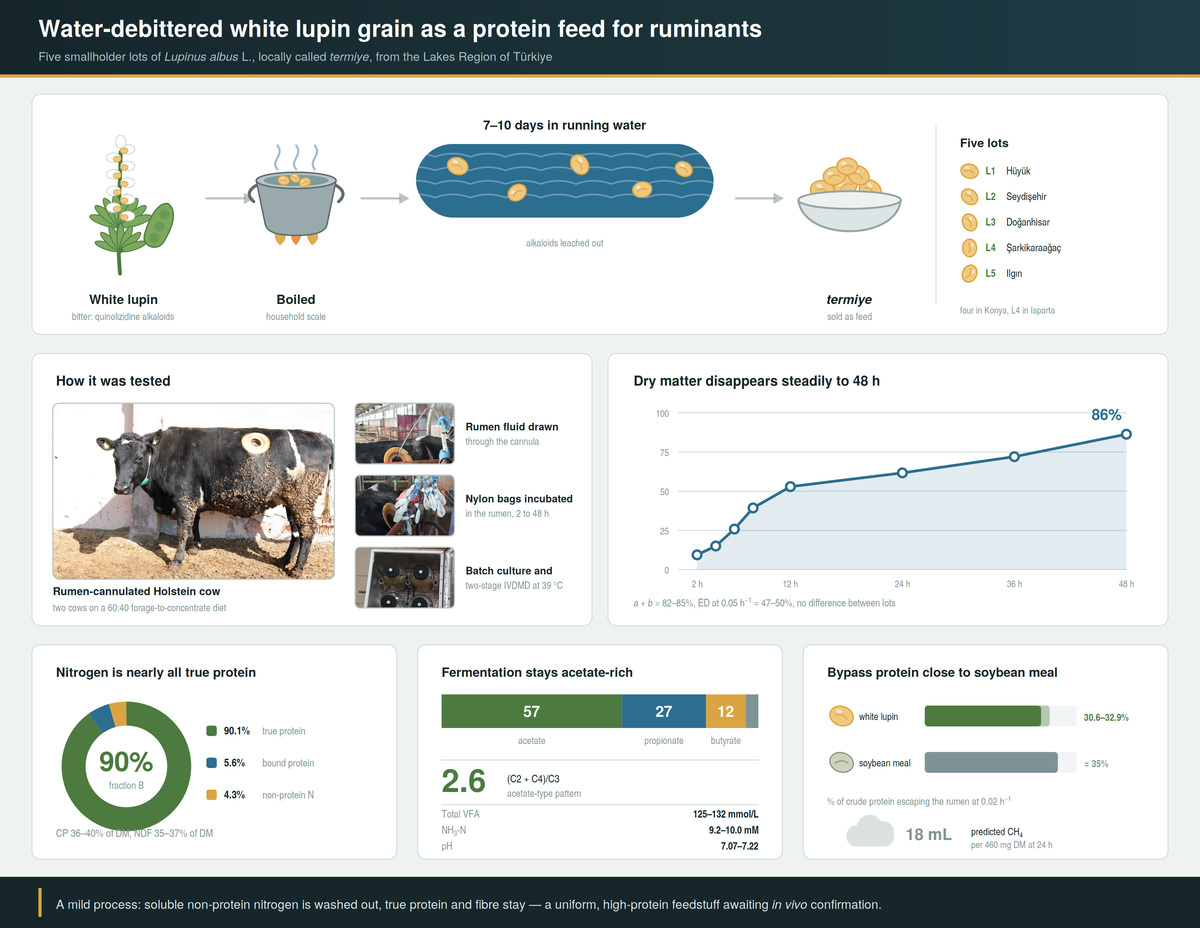
White lupin (Lupinus albus L.) grains, locally known in Anatolia as termiye, is traditionally boiled and soaked under running water for 7–10 days to remove quinolizidine alkaloids. However, little is known about its nutritive value for ruminants after this processing. In this study, water-debittered L. albus from five smallholder production lots (L1–L5) was characterised for chemical composition, Cornell Net Carbohydrate and Protein System (CNCPS) protein fractions, in situ degradability, in vitro fermentation kinetics, and predicted methane production. In situ degradability was determined in two rumen-cannulated dry Holstein cows over 2–48 h. In vitro fermentation was assessed using a semi-automatic gas production system. Rumen pH, ammonia nitrogen (NH3-N) and volatile fatty acids (VFA) were measured at 24 and 48 h, and methane production was predicted from VFA molar proportions. Crude protein (CP) content ranged from 35.8 to 40.2% of dry matter (DM) and neutral detergent fibre (NDF) content from 35.3 to 36.9% of DM. CNCPS fraction B accounted for 88.0–93.2% of CP and rumen-undegradable protein (RUP) at k = 0.02/h was 30.6–32.9% of CP. Twenty-four-hour gas production ranged from 58 to 68 ml/460 mg DM, end-point pH 7.07–7.22, NH3 N 9.2–10.0 mM, total VFA 125–132 mmol/l, acetate 55.9–58.2 mol%, propionate 26.2–27.1 mol%, and the (acetate + butyrate)/propionate ratio 2.54–2.69. Predicted methane ranged from 17.7 to 18.5 ml/460 mg DM. Water-debittered L. albus had high CP content, a true-protein-dominated nitrogen profile, RUP comparable to soybean meal, and an acetate-rich fermentation profile. Composition and fermentation characteristics were largely consistent between lots, indicating that traditional aqueous debittering results in a relatively uniform protein feed. However, confirmation of its feeding value requires in vivo evaluation.
ACKNOWLEDGEMENTS
The authors thank the research farm staff of the Faculty of Veterinary Medicine, Selçuk University, for their assistance with the rumen- cannulated cows.
CONFLICT OF INTEREST
The Authors declare that there is no conflict of interest.
REFERENCES (30)
1.
Annicchiarico P., Manunza P., Arnoldi A., Boschin G., 2014. Quality of Lupinus albus L. (white lupin) seed: extent of genotypic and environmental effects. J. Agric. Food Chem. 62, 6539–6545, https://doi.org/10.1021/jf4056....
2.
AOAC, 2005. Official Methods of Analysis. 18th Ed. Association of Official Analytical Chemists. Gaithersburg, MD (USA).
3.
Aufrère J., Graviou D., Demarquilly C., Vérité R., Michalet-Doreau B., Chapoutot P., 1991. Predicting in situ degradability of feed proteins in the rumen by two laboratory methods (solubility and enzymatic degradation). Anim. Feed Sci. Technol. 33, 97–116, https://doi.org/10.1016/0377-8....
4.
Blümmel M., Steingass H., Becker K., 1997. The relationship between in vitro gas production, in vitro microbial biomass yield and 15N incorporation and its implications for the prediction of voluntary feed intake of roughages. Br. J. Nutr. 77, 911–921, https://doi.org/10.1079/BJN199....
5.
Chávez-Solis A.U., Ábrego-García A., Albores-Moreno S., Hernández-Sánchez D., Yáñez-Vergara A.G., Escobar-Álvarez J.L., López-Perea P., 2026. In vitro methods for assessing gas production and rumen digestibility: methodological considerations, advantages, and limitations. J. Microbiol. Methods 247, 107566, https://doi.org/10.1016/j.mime....
6.
Chamone M.E.R., Ascheri J.L.R., Vargas-Solórzano J.W., Stephan M.P., Carvalho C.W.P., 2023. Chemical characterization of white lupin (Lupinus albus) flour treated by extrusion cooking and aqueous debittering processes. Plant Foods Hum. Nutr. 78, 292–298, https://doi.org/10.1007/s11130....
7.
FAO, 2022. FAOSTAT Statistical Database. Food and Agriculture Organization of the United Nations. Rome (Italy).
8.
Gresta F., Oteri M., Scordia D., Costale A., Armone R., Meineri G., Chiofalo B., 2023. White lupin (Lupinus albus L.), an alternative legume for animal feeding in the Mediterranean area. Agriculture 13, 434, https://doi.org/10.3390/agricu....
9.
Janssen P.H., 2010. Influence of hydrogen on rumen methane formation and fermentation balances through microbial growth kinetics and fermentation thermodynamics. Anim. Feed Sci. Technol. 160, 1–22, https://doi.org/10.1016/j.anif....
10.
Joch M., Kudrna V., 2020. Partial replacement of soybean meal by white lupine seeds in the diet of dairy cows. Asian-Australas. J. Anim. Sci. 33, 957–964, https://doi.org/10.5713/ajas.1....
11.
Licitra G., Hernandez T.M., Van Soest P.J., 1996. Standardization of procedures for nitrogen fractionation of ruminant feeds. Anim. Feed Sci. Technol. 57, 347–358, https://doi.org/10.1016/0377-8....
12.
López S., Dhanoa M.S., Dijkstra J., Bannink A., Kebreab E., France J., 2007. Some methodological and analytical considerations regarding application of the gas production technique. Anim. Feed Sci. Technol. 135, 139–156, https://doi.org/10.1016/j.anif....
13.
Menke K.H., Steingass H., 1988. Estimation of the energetic feed value obtained from chemical analysis and in vitro gas production using rumen fluid. Anim. Res. Develop. 28, 7–55.
14.
Morsy T.A., Kholif A.E., Adegbeye M.J., Olafadehan O.A., Gouda G.A., Fahmy M., Chahine M., 2024. Lupin seed supplementation as a functional feed additive: in vitro ruminal gas, methane and carbon dioxide production, fermentation kinetics, and nutrient degradability. Animals 14, 2119, https://doi.org/10.3390/ani141....
15.
NRC, 2001. Nutrient Requirements of Dairy Cattle. 7th rev. edn. National Academy Press. Washington, DC (USA).
16.
Ørskov E.R., McDonald I., 1979. The estimation of protein degradability in the rumen from incubation measurements weighted according to rate of passage. J. Agric. Sci. 92, 499–503, https://doi.org/10.1017/S00218....
17.
Russell J.B., Wilson D.B., 1996. Why are ruminal cellulolytic bacteria unable to digest cellulose at low pH? J. Dairy Sci. 79, 1503–1509, https://doi.org/10.3168/jds.S0....
18.
Satter L.D., Slyter L.L., 1974. Effect of ammonia concentration on rumen microbial protein production in vitro. Br. J. Nutr. 32, 199–208, https://doi.org/10.1079/BJN197....
19.
Schofield P., Pitt R.E., Pell A.N., 1994. Kinetics of fiber digestion from in vitro gas production. J. Anim. Sci. 72, 2980–2991, https://doi.org/10.2527/1994.7....
20.
Schwab C.G., Broderick G.A., 2017. A 100-year review: protein and amino acid nutrition in dairy cows. J. Dairy Sci. 100, 10094–10112, https://doi.org/10.3168/jds.20....
21.
Sniffen C.J., O'Connor J.D., Van Soest P.J., Fox D.G., Russell J.B., 1992. A net carbohydrate and protein system for evaluating cattle diets: II. Carbohydrate and protein availability. J. Anim. Sci. 70, 3562–3577, https://doi.org/10.2527/1992.7....
22.
Sujak A., Kotlarz A., Strobel W., 2006. Compositional and nutritional evaluation of several lupin seeds. Food Chem. 98, 711–719, https://doi.org/10.1016/j.food....
23.
Tilley J.M.A., Terry R.A., 1963. A two-stage technique for the in vitro digestion of forage crops. Grass Forage Sci. 18, 104–111, https://doi.org/10.1111/j.1365....
24.
Titze N., Krieg J., Steingass H., Rodehutscord M., 2019. Variation of lupin protein degradation in ruminants studied in situ and using chemical protein fractions. Animal 13, 709–717, https://doi.org/10.1017/S17517....
25.
Uzun B., Arslan Ç., Karhan M., Toker C., 2007. Fat and fatty acids of white lupin (Lupinus albus L.) in comparison to sesame (Sesamum indicum L.). Food Chem. 102, 45–49, https://doi.org/10.1016/j.food....
26.
Van Soest P.J., Robertson J.B., Lewis B.A., 1991. Methods for dietary fiber, neutral detergent fiber, and nonstarch polysaccharides in relation to animal nutrition. J. Dairy Sci. 74, 3583–3597, https://doi.org/10.3168/jds.S0....
27.
Weatherburn M.W., 1967. Phenol-hypochlorite reaction for determination of ammonia. Anal. Chem. 39, 971–974, https://doi.org/10.1021/ac6025....
28.
Wolin M.J., 1960. A theoretical rumen fermentation balance. J. Dairy Sci. 43, 1452–1459, https://doi.org/10.3168/jds.S0....
29.
Yáñez-Ruiz D.R., Moumen A., García A.I.M., Molina-Alcaide E., 2004. Ruminal fermentation and degradation patterns, protozoa population and urinary purine derivatives excretion in goats and wethers fed diets based on two-stage olive cake: effect of PEG supply. J. Anim. Sci. 82, 2023–2032, https://doi.org/10.2527/2004.8....
30.
Yang W.Z., Beauchemin K.A., 2007. Altering physically effective fiber intake through forage proportion and particle length: chewing and ruminal pH. J. Dairy Sci. 90, 2826–2838, https://doi.org/10.3168/jds.20....
Share
RELATED ARTICLE
| ISSN: | 1230-1388 |

Assigning DOI numbers, introducing articles from supplements and recent publications to POL-index database, maintaining anti-plagiarism detection, electronic system to proceed manuscripts and webpage of the Journal with interactive pdf files, and language correction of manuscripts published in Journal of Animal and Feed Sciences are financed in the years 2018–2019 by the Ministry of Science and Higher Education from the funds for science popularization activities, Agreement No. 631/P-DUN/2018.

© 2006-2026 Journal hosting platform by Bentus
We process personal data collected when visiting the website. The function of obtaining information about users and their behavior is carried out by voluntarily entered information in forms and saving cookies in end devices. Data, including cookies, are used to provide services, improve the user experience and to analyze the traffic in accordance with the Privacy policy. Data are also collected and processed by Google Analytics tool (more).
You can change cookies settings in your browser. Restricted use of cookies in the browser configuration may affect some functionalities of the website.
You can change cookies settings in your browser. Restricted use of cookies in the browser configuration may affect some functionalities of the website.