Current issue
Online first
Archive
About the Journal
Editorial Office
Editorial Board
Copy right and self-archiving policy
Peer review process
Instructions for Reviewers
Printed version subscription
Abstracting and indexing
Contact
Instructions for Authors
Policies
General information
Open Access, Licensing terms, Commercial use and Copyright terms policies
Self-archiving policy and Archive policies
Article Correction and Withdrawal policy
Manuscript Submission policy
Authorship policy
Conflict of Interest policy
Language considerations policy
Plagiarism and Duplicate publications policy
Ethics policy
Review process policy
Acceptance of manuscripts policy
Online First Articles and Special Issues policies
Generative artificial intelligence (AI) policy
Advertising policy
Article publication charges
Policies
General information
Open Access, Licensing terms, Commercial use and Copyright terms policies
Self-archiving policy and Archive policies
Article Correction and Withdrawal policy
Manuscript Submission policy
Authorship policy
Conflict of Interest policy
Language considerations policy
Plagiarism and Duplicate publications policy
Ethics policy
Review process policy
Acceptance of manuscripts policy
Online First Articles and Special Issues policies
Generative artificial intelligence (AI) policy
Advertising policy


ORIGINAL PAPER
Effect of spent brewer’s yeast (Saccharomyces cerevisiae)
inclusion on the physical characteristics, water activity,
and stability of fish feed
1
University of Florida, College of Agricultural and Life Sciences, Department of Food Science and Human Nutrition, Gainesville 32611, USA
2
University of Florida, College of Agricultural and Life Sciences, Department of Fisheries & Aquatic Sciences, Gainesville 32611, USA
3
University of Florida, College of Agricultural and Life Sciences, Food Science and Human Nutrition Department and Florida Sea Grant, University of Florida, Gainesville 32611, USA
Publication date: 2026-05-06
Corresponding author
A. J MacIntosh
University of Florida, College of Agricultural and Life Sciences, Department of Food Science and Human Nutrition, Gainesville 32611, USA
University of Florida, College of Agricultural and Life Sciences, Department of Food Science and Human Nutrition, Gainesville 32611, USA
J. Anim. Feed Sci. 2026;35(2):e27
KEYWORDS
TOPICS
ABSTRACT
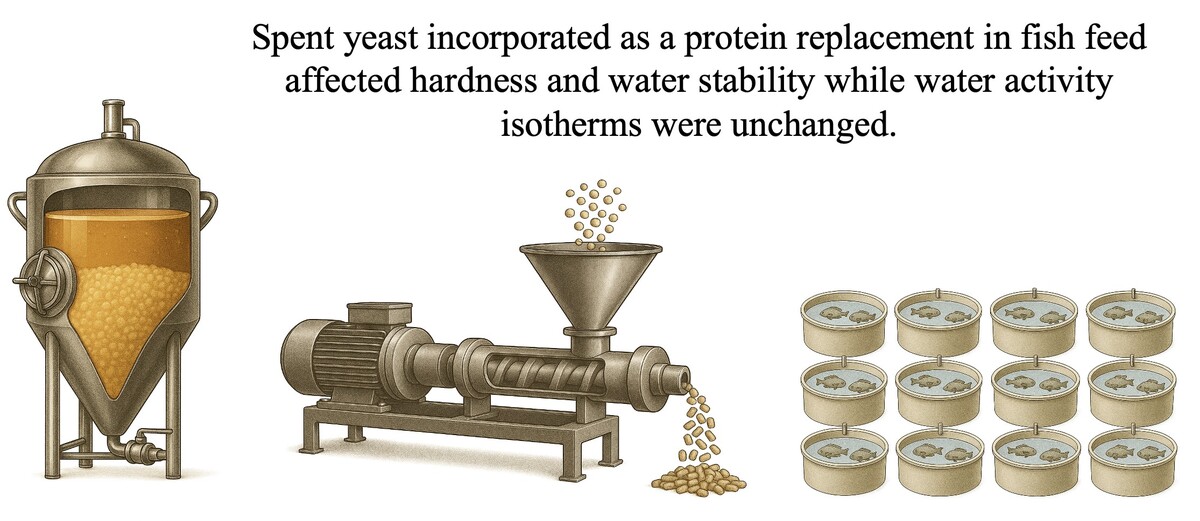
Spent yeast from brewing fermentations is a potential alternative
protein source to fishmeal in aquafeed formulations. Using an easily replenished
waste stream as a protein replacement would assist with sustainable aquaculture
production. Therefore, the primary goal of this study was to assess physical
properties of a fishmeal-based aquafeed containing spent brewer’s yeast as
a partial protein substitute. This was performed by comparing three pelletized
feed formulations containing no yeast, live yeast, and a thermally lysed (dead)
yeast. Four primary physical characteristics of the feeds were tested including
macronutrient content, texture, water activity, and water stability. For assessment
of physical parameters, pellets were dried to ~15% moisture content on a wet
basis (MCwb) and ~5% MCwb. Moisture sorption isotherms were practically
identical across all three feed formulations, indicating that significant modification
of preparatory practices when extruding yeast-modified fish feeds is not needed.
Maximum hardness was positively correlated with moisture content and with
yeast inclusion. The water stability was lower at lower moisture contents over
the course of the first two hours of sampling, but was not correlated after four
hours, and decreased with yeast inclusion. Water stability was the lowest for
live-yeast inclusive feeds, in which almost all (~90%) solids were lost after 240
min of water exposure. This study examined several key physical effects which
incorporating living or dead yeast into an extruded fish feed would be expected
to cause, thus forwarding their development as a sustainable protein alternative.
ACKNOWLEDGEMENTS
The authors would like to acknowledge First Magnitude Brewing Company for their many donations of SBY, and technical support throughout the project. We would also like to acknowledge student support provided by the Lee C. Yeoman’s Fisheries and Aquatic Sciences Fellowship Fund, as well as by the Department of Food Science and Human Nutrition of the University of Florida.
FUNDING
This research did not receive any specific grant from funding agencies in the public, commercial, or not-for-profit sectors.
CONFLICT OF INTEREST
The Authors declare that there is no conflict of interest.
REFERENCES (45)
1.
Adya A.K., Canetta E., Walker G.M., 2006. Atomic force microscopy study of the influence of physical stresses on Saccharomyces cervisiae and Schizosaccharomyces pombe. FEMS Yeast Res. 6, 120–128, https://doi.org/10.1111/j.1567....
2.
AOAC International, 2012. Official Methods of Analysis of AOAC International 19th edition. Gaithersburg, MD (USA), Official Method 920.39.
3.
AOAC International, 2012. Official Methods of Analysis of AOAC International 19th edition. Gaithersburg, MD (USA), Official Method 923.03.
4.
AOAC International, 2012. Official Methods of Analysis of AOAC International 19th edition. Gaithersburg, MD (USA), Official Method 984.25.
5.
AOAC International, 2012. Official Methods of Analysis of AOAC IInternational 19th edition. Gaithersburg, MD (USA), Official Method 992.15.
6.
Baeverfjord G., Refstie S., Krogedal P., Åsgård T., 2006. Low feed pellet water stability and fluctuating water salinity cause separation and accumulation of dietary oil in the stomach of rainbow trout (Oncorhynchus mykiss). Aquaculture 261, 1335–1345, https://doi.org/10.1016/j.aqua....
7.
Banu R., Akter S., Islam R., Mondol N., Hossain A., 2020. Probiotic yeast enhanced growth performance and disease resistance in freshwater catfish gulsa tengra, Mystus cavasius. Aquac. Rep. 16, 100237, https://doi.org/10.1016/j.aqre....
8.
Barbosa-Cánovas G.V., Fontana A.J. Jr., Schmidt S.J., Labuza T.P., 2007. Water Activity in Foods: Fundamentals and Applications. John Wiley & Sons. Hoboken, NJ (USA), pp. 405, https://doi.org/10.1002/978047....
9.
Blahovec J., Yanniotis S., 2008. GAB Generalized equation for sorption phenomena. Food Bioprocess Technol. 1, 82–90, https://doi.org/10.1007/s11947....
10.
Brewers Association, 2017. Wastewater Management Guidance Manual. Boulder, CO (USA).
11.
Covert V.L., Farzard R., Li M., Thompson-Witrick K.A., MacIntosh A.J., 2025. Spent brewer’s yeast as an alternative ingredient in aquafeed. J. Am. Soc. Brew. Chem. 83, 1–16, https://doi.org/10.1080/036104....
12.
Craig S., Helfrich L., Kuhn D.D., Schwarz M.H., 2017. Understanding fish nutrition, feeds, and feeding. Proceedings of Virginia Cooperative Extension. Blacksburg (USA). publication 420–256.
13.
FAO, WHO, UNU, 1985. Energy and Protein Requirements. World Health Organization. Geneva (Switzerland).
14.
FDA, 1984. Water Activity (aw) in Foods. U.S. Food and Drug Administration. Silver Spring, MD (USA).
15.
Ferreira I.M.P.L.V.O., Pinho O., Vieira E., Tavarela J.G., 2010. Brewer’s Saccharomyces yeast biomass: characteristics and potential applications. Trends Food Sci. Technol. 21, 77–84, https://doi.org/10.1016/j.tifs....
16.
Froehlich H.E., Jacobsen N.S., Essington T.E., Clavelle T., Halpern B.S., 2018. Avoiding the ecological limits of forage fish for fed aquaculture. Nat. Sustain. 1, 298–303, https://doi.org/10.1038/s41893....
17.
Gatesoupe F.J., 2007. Live yeasts in the gut: Natural occurrence, dietary introduction, and their effects on fish health and development. Aquaculture 267, 20–30, https://doi.org/10.1016/j.aqua....
18.
Hansen J.Ø., Storebakken T., 2007. Effects of dietary cellulose level on pellet quality and nutrient digestibilities in rainbow trout (Oncorhynchus mykiss). Aquaculture. 272, 458–465, https://doi.org/10.1016/j.aqua....
19.
Hilton J.W., Cho C.Y., Slinger S.J., 1981. Effect of extrusion processing and steam pelleting diets on pellet durability, pellet water absorption and the physiological response of rainbow trout (Salmo gairdneri). Aquaculture 25, 185–194, https://doi.org/10.1016/0044-8....
20.
Huige N.J., 2006. Bewery by-products and effluents. In: G.G. Stewart, F.G. Priest (Editors). Handbook of Brewing (2nd edition). CRC Press. Boca Raton, FL (USA), pp. 656-707, https://doi.org/10.1201/978142....
21.
Jaeger A., Arendt E.K., Zannini E., Sahin A.W., 2020. Brewer’s spent yeast (BSY), an underutilized brewing by-product. Fermentation 6, 123, https://doi.org/10.3390/fermen....
22.
Kerby C., Vriesekoop F., 2017. An overview of the utilisation of brewery by-products as generated by british craft breweries. Beverages. 3, 24, https://doi.org/10.3390/bevera....
23.
Lara-Flores M., Olvera-Novoa M.A., Guzmán-Méndez B.E., López-Madrid W., 2003. Use of the bacteria Streptococcus faecium and Lactobacillus acidophilus, and the yeast Saccharomyces cerevisiae as growth promoters in Nile tilapia (Oreochromis niloticus). Aquaculture 216, 193–201, https://doi.org/10.1016/S0044-....
24.
Lee J.K., Lee T., Chuah S.X.Y., Omidvar R., Ropicki A., MacIntosh A.J., Farzad R., 2025a. Effect of spent brewer’s yeast inclusion as a feed additive on Nile tilapia (Oreochromis niloticus) production, colour, and fillet proximate composition. Aquac. Fish & Fisheries 5, e70065, https://doi.org/10.1002/aff2.7....
25.
Lee J.K., Farzad R., Lee T., Chuah S.X.Y., Omidvar R., Sims C., Zhang B., Ropicki A., MacIntosh A.J., 2025b. Effect of hop acid inclusion as a feed additive on Nile tilapia, Oreochromis niloticus, production, lysozyme activity, fillet color, and aroma. J. World Aquac. Soc. 56, e70014, https://doi.org/10.1111/jwas.7....
26.
Lewicki P.P., 2008. The applicability of the GAB model to food water sorption isotherms. Int. J. Food Sci. Technol. 32, 553–557, https://doi.org/10.1111/j.1365....
27.
Lowe J.A., Kershaw S.J., 1995. Water activity-moisture content relationship as a predictive indicator for control of spoilage in commercial pet diet components. Anim. Feed Sci. Technol. 56, 187–194, https://doi.org/10.1016/0377-8....
28.
Manitoba Agriculture Office, 2018. Guidelines for Estimating Aquaculture Production Costs 2018 in Manitoba. Manitoba (Canada).
29.
Mateo-Sagasta J., Zadeh S.M., Turral H., 2017. Water Pollution from Agriculture: A Global Review - Executive summary. FAO. Rome (Italy).
30.
Miles R.D., Chapman F.A., 2007. What are nutrient-dense fish feeds and their importance in aquaculture? University of Florida Institute of Food and Agricultural Sciences. Gainesville (USA). EDIS 2007 (17) publication FA145, https://doi.org/10.32473/edis-....
31.
Nemenyi J., Pitts E.R., Martin-Ryals A., Boz Z., Zhang B., Jia Z., Budner D., MacIntosh A.J., Thompson-Witrick K.A., 2024. The effect of mixed culture fermentation of Saccharomyces cerevisiae and Saccharomyces cerevisiae var. diastaticus on fermentation parameters and flavor profile. J. Food Sci. 89, 513–522, https://doi.org/10.1111/1750-3....
32.
Pedersen L.-F., Suhr K.I., Dalsgaard J., Pedersen P.B., Arvin E., 2012. Effects of feed loading on nitrogen balances and fish performance in replicated recirculating aquaculture systems. Aquaculture, 237–245, https://doi.org/10.1016/j.aqua....
33.
Quirijns E.J., van Boxtel A.J.B., van Loon W.K.P., van Straten G., 2005. Sorption isotherms, GAB parameters and isosteric heat of sorption. J. Sci. Food Agric. 85, 1805–1814, https://doi.org/10.1002/jsfa.2....
34.
Ran C., Huang L., Hu J. et al., 2016. Effects of dietary live and heat-inactive baker’s yeast on growth, gut health, and disease resistance of Nile tilapia under high rearing density. Fish Shellfish Immunol. 56, 263–271, https://doi.org/10.1016/j.fsi.....
35.
Salwin H., 1959. Defining minimum moisture contents for dehydrated foods. Food Technol. 13, 594–595.
36.
Serviss M.T., van Hout D., Britton S.J., MacIntosh A.J., 2025. Brewing for the future: balancing tradition and sustainability. J. Am. Soc. Brew. Chem. 1–19, https://doi.org/10.1080/036104....
37.
Sheikhzadeh N., Heidarieh M., Pashaki A.K., Nofouzi K., Farshbafi M.A., Akbari M., 2012. Hilyses®, fermented Saccharomyces cerevisiae, enhances the growth performance and skin non-specific immune parameters in rainbow trout (Oncorhynchus mykiss). Fish Shellfish Immunol. 32, 1083–1087, https://doi.org/10.1016/j.fsi.....
38.
Siwicki A.K., Anderson D.P., Rumsey G.L., 1994. Dietary intake of immunostimulants by rainbow trout affects non-specific immunity and protection against furunculosis. Vet. Immunol. Immunopathol. 41, 125–139, https://doi.org/10.1016/0165-2....
39.
Sørensen M., Ljøkjel K., Storebakken T., Shearer K.D., Skrede A., 2002. Apparent digestibility of protein, amino acids and energy in rainbow trout (Oncorhynchus mykiss) fed a fish meal based diet extruded at different temperatures. Aquaculture 211, 215–225, https://doi.org/10.1016/S0044-....
40.
Sørensen M., Nguyen G., Storebakken T., Øverland M., 2010. Starch source, screw configuration and injection of steam into the barrel affect the physical quality of extruded fish feed. Aquac. Res. 41, 419–432, https://doi.org/10.1111/j.1365....
41.
Sørensen M., 2012. A review of the effects of ingredient composition and processing conditions on the physical qualities of extruded high-energy fish feed as measured by prevailing methods. Aquac. Nutr. 18, 233–248, https://doi.org/10.1111/j.1365....
42.
Thomas M., van der Poel A.F.B., 1996. Physical quality of pelleted animal feed 1. Criteria for pellet quality. Anim. Feed Sci. Technol. 61, 89–112, https://doi.org/10.1016/0377-8....
43.
Timmermann E.O., Chirife J., Iglesias H.A., 2001. Water sorption isotherms of foods and foodstuffs: BET or GAB parameters? J. Food Eng. 48, 19–31, https://doi.org/10.1016/S0260-....
44.
Tschirner M., Kloas W., 2017. Increasing the sustainability of aquaculture systems: Insects as alternative protein source for fish diets. GAIA. 26(4), 332–340, https://doi.org/10.14512/gaia.....
45.
Vieira E.F., Carvalho J., Pinto E., Cunha S., Almeida A.A., Ferreira I.M.P.L.V.O., 2016. Nutritive value, antioxidant activity and phenolic compounds profile of brewer’s spent yeast extract. J. Food Compos. Anal. 52, 44–51, https://doi.org/10.1016/j.jfca....
Share
RELATED ARTICLE
| ISSN: | 1230-1388 |

Assigning DOI numbers, introducing articles from supplements and recent publications to POL-index database, maintaining anti-plagiarism detection, electronic system to proceed manuscripts and webpage of the Journal with interactive pdf files, and language correction of manuscripts published in Journal of Animal and Feed Sciences are financed in the years 2018–2019 by the Ministry of Science and Higher Education from the funds for science popularization activities, Agreement No. 631/P-DUN/2018.

© 2006-2026 Journal hosting platform by Bentus
We process personal data collected when visiting the website. The function of obtaining information about users and their behavior is carried out by voluntarily entered information in forms and saving cookies in end devices. Data, including cookies, are used to provide services, improve the user experience and to analyze the traffic in accordance with the Privacy policy. Data are also collected and processed by Google Analytics tool (more).
You can change cookies settings in your browser. Restricted use of cookies in the browser configuration may affect some functionalities of the website.
You can change cookies settings in your browser. Restricted use of cookies in the browser configuration may affect some functionalities of the website.