Current issue
Online first
Archive
About the Journal
Editorial Office
Editorial Board
Copy right and self-archiving policy
Peer review process
Instructions for Reviewers
Printed version subscription
Abstracting and indexing
Contact
Instructions for Authors
Policies
General information
Open Access, Licensing terms, Commercial use and Copyright terms policies
Self-archiving policy and Archive policies
Article Correction and Withdrawal policy
Manuscript Submission policy
Authorship policy
Conflict of Interest policy
Language considerations policy
Plagiarism and Duplicate publications policy
Ethics policy
Review process policy
Acceptance of manuscripts policy
Online First Articles and Special Issues policies
Generative artificial intelligence (AI) policy
Advertising policy
Article publication charges
Policies
General information
Open Access, Licensing terms, Commercial use and Copyright terms policies
Self-archiving policy and Archive policies
Article Correction and Withdrawal policy
Manuscript Submission policy
Authorship policy
Conflict of Interest policy
Language considerations policy
Plagiarism and Duplicate publications policy
Ethics policy
Review process policy
Acceptance of manuscripts policy
Online First Articles and Special Issues policies
Generative artificial intelligence (AI) policy
Advertising policy

ORIGINAL PAPER
Small-intestinal microbiota patterns in growing Hu sheep fed low-protein diets with rumen-protected lysine and methionine
1
Yangzhou University, College of Animal Sciences and Technology, Yangzhou 225009, China
2
State Key Laboratory of Sheep Genetic Improvement and Healthy Production, Xinjiang Academy of Agricultural Reclamation Sciences, Shihezi, Xinjiang 832000, China
These authors had equal contribution to this work
Publication date: 2026-08-27
Corresponding author
X. Zhang
State Key Laboratory of Sheep Genetic Improvement and Healthy Production, Xinjiang Academy of Agricultural Reclamation Sciences, Shihezi, Xinjiang 832000, China
State Key Laboratory of Sheep Genetic Improvement and Healthy Production, Xinjiang Academy of Agricultural Reclamation Sciences, Shihezi, Xinjiang 832000, China
KEYWORDS
16S rRNA sequencingamino acid supplementationbacterial communityfunctional inferenceHu sheepnitrogen utilization
TOPICS
ABSTRACT
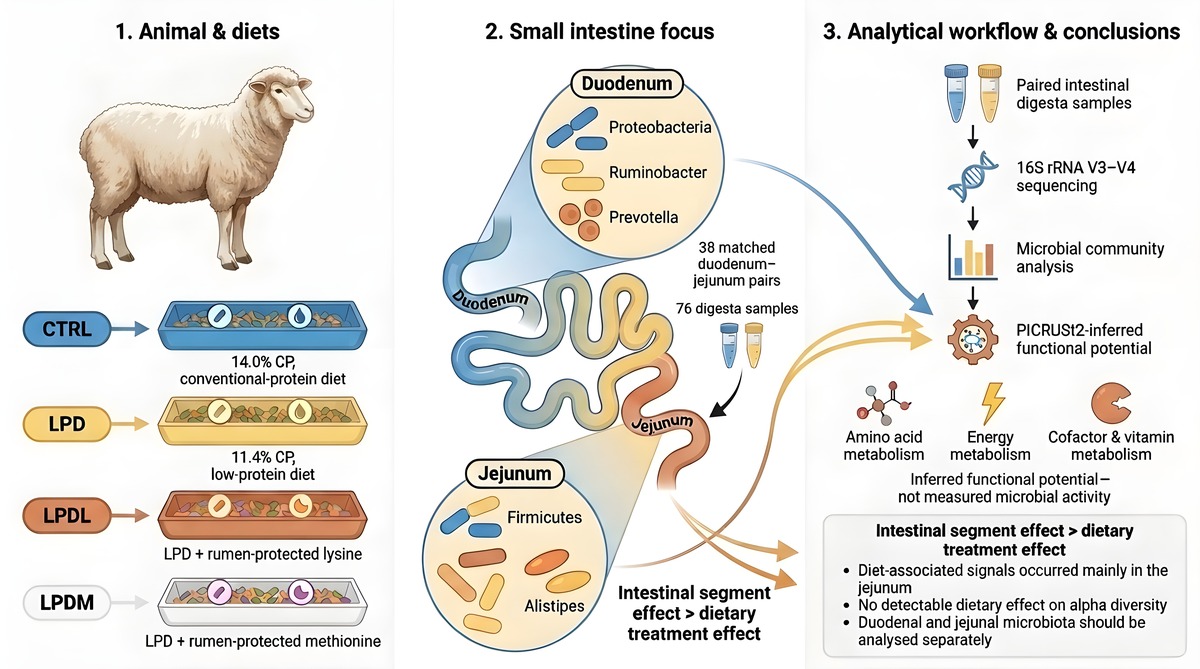
Dietary crude protein reduction and supplementation with rumen-protected amino acids may improve nitrogen utilisation in sheep; however, their effects on different small-intestinal sites remain unknown. This study investigated the digesta microbiota in paired duodenal and jejunal samples from 38 growing male Hu sheep fed one of four experimental diets: a conventional protein control diet, a low-protein diet (LPD), an LPD supplemented with rumen-protected lysine (LPDL), and an LPD supplemented with rumen-protected methionine (LPDM). Overall, 76 paired digesta samples representing 38 matched duodenum-jejunum pairs were analysed using 16S rRNA gene sequencing, and PICRUSt2 was employed to predict microbial functional potential. Host-response parameters, including serum biochemical, antioxidant, and immune-related indicators, were analysed to provide additional physiological context. In both intestinal segments, dietary treatment had no effect on alpha diversity. Richness-based indices, community structure (Bray-Curtis), dominant taxa, and inferred functional potential differed between the duodenal and jejunal communities. The effect of intestinal segment was greater than that of dietary treatment, and taxonomic and predicted functional differences associated with diet were observed primarily in the jejunum. Serum catalase activity differed between treatments after false discovery rate correction, with lower activity in the LPDM group; however, this finding was considered contextual rather than mechanistic. Overall, intestinal segments showed a stronger association with the small-intestinal microbial pattern than dietary treatment, suggesting that the duodenal and jejunal microbiota should be investigated separately in ruminant nutritional trials.
ACKNOWLEDGEMENTS
The authors would like to thank the College of Animal Science and Technology, Yangzhou University, China, for support and laboratory facilities.
FUNDING
This work was supported by the Bintuan Key R&D Project (2024AB033, 2023AB078), the Ministry of Science and Technology of China’s High-end Foreign Experts Program (H20250797), the Huaian Talent Enclave Expert Workstation Program, and the Priority Academic Program Development of Jiangsu Higher Education Institution (PAPD), P.R. China. Laboratory facilities and equipment were provided by the College of Animal Science and Technology, Yangzhou University, China.
CONFLICT OF INTEREST
The Authors declare that there is no conflict of interest.
REFERENCES (19)
1.
Abdallah A., Elemba E., Zhong Q., Sun Z., 2020. Gastrointestinal interaction between dietary amino acids and gut microbiota: with special emphasis on host nutrition. Curr. Protein Pept. Sci. 21, 785–798, https://doi.org/10.2174/138920....
2.
Anderson M.J., 2001. A new method for non-parametric multivariate analysis of variance. Austral Ecol. 26, 32–46, https://doi.org/10.1111/j.1442....
3.
Basile E.J., Shukla K., Launico M.V., Sheer A.J., 2025. Physiology, nutrient absorption. In: StatPearls [Internet]. StatPearls Publishing. Treasure Island, FL (USA). Available from: https://www.ncbi.nlm.nih.gov/b....
4.
Benjamini Y., Hochberg Y., 1995. Controlling the false discovery rate: a practical and powerful approach to multiple testing. J. R. Stat. Soc. Ser. B Methodol. 57, 289–300, https://doi.org/10.1111/j.2517....
5.
Bokulich N.A., Kaehler B.D., Rideout J.R., Dillon M., Bolyen E., Knight R., Huttley G.A., Caporaso J.G., 2018. Optimizing taxonomic classification of marker-gene amplicon sequences with QIIME 2’s q2-feature-classifier plugin. Microbiome 6, 90, https://doi.org/10.1186/s40168....
6.
Bolyen E., Rideout J.R., Dillon M.R. et al., 2019. Reproducible, interactive, scalable and extensible microbiome data science using QIIME 2. Nat. Biotechnol. 37, 852–857, https://doi.org/10.1038/s41587....
7.
Cholewińska P., Czyż K., Nowakowski P., Wyrostek A., 2020. The microbiome of the digestive system of ruminants: a review. Anim. Health Res. Rev. 21, 3–14, https://doi.org/10.1017/S14662....
8.
Cholewińska P., Górniak W., Wojnarowski K., 2021. Impact of selected environmental factors on microbiome of the digestive tract of ruminants. BMC Vet. Res. 17, 25, https://doi.org/10.1186/s12917....
9.
Gebeyew K., Yang C., He Z., Tan Z., 2021. Low-protein diets supplemented with methionine and lysine alter the gut microbiota composition and improve the immune status of growing lambs. Appl. Microbiol. Biotechnol. 105, 8393–8410, https://doi.org/10.1007/s00253....
10.
Martin M., 2011. Cutadapt removes adapter sequences from high-throughput sequencing reads. EMBnet.journal 17, 10–12, https://doi.org/10.14806/ej.17....
11.
Pereira F.C., Berry D., 2017. Microbial nutrient niches in the gut. Environ. Microbiol. 19, 1366–1378, https://doi.org/10.1111/1462-2....
12.
Quast C., Pruesse E., Yilmaz P., Gerken J., Schweer T., Yarza P., Peplies J., Glöckner F.O., 2013. The SILVA ribosomal RNA gene database project: improved data processing and web-based tools. Nucleic Acids Res. 41, D590–D596, https://doi.org/10.1093/nar/gk....
13.
Rawal S., Kaur H., Bhathan S., Mittal D., Kaur G., Ali S.A., 2024. Ruminant gut microbiota: interplay, implications, and innovations for sustainable livestock production. In: V.K. Yata, A.K. Mohanty, E. Lichtfouse (Editors). Sustainable Agriculture Reviews: Animal Biotechnology for Livestock Production 4. Springer Nature. Cham (Switzerland), pp. 205–228, https://doi.org/10.1007/978-3-....
14.
Wang L., Liu K., Wang Z., Bai X., Peng Q., Jin L., 2019. Bacterial community diversity associated with different utilization efficiencies of nitrogen in the gastrointestinal tract of goats. Front. Microbiol. 10, 239, https://doi.org/10.3389/fmicb.....
15.
Wang X.L., Zhou J., Lu M.L., Zhao S.P., Li W.J., Quan G.B., Xue B., 2025. Mucosal barrier function and microbial community of small intestines in sheep in response to dietary energy concentrations. Animal 19, 101550, https://doi.org/10.1016/j.anim....
16.
Wei X., Wu H., Wang Z., Zhu J., Wang W., Wang J., Wang Y., Wang C., 2023. Rumen-protected lysine supplementation improved amino acid balance, nitrogen utilization and altered hindgut microbiota of dairy cows. Anim. Nutr. 15, 320–331, https://doi.org/10.1016/j.anin....
17.
Wu W., Akhtar M.F., Geng J., Lu H., Rahim M.A., Cheng J., Ding X., Mao S., Xue Y., 2025. Undernutrition disrupts jejunal and ileal microbiota and epithelial tissue homeostasis in a pregnant sheep model. Anim. Nutr. 20, 263–276, https://doi.org/10.1016/j.anin....
18.
Zhang F., Wu Z., Zhang Y., Su Q., Zhu K., Chen X., Hou S., Gui L., 2025. Different lysine-to-methionine ratios in a low-protein diet affect the microbiome and metabolome, influencing the jejunal barrier function in Tibetan sheep. Front. Microbiol. 16, 1441143, https://doi.org/10.3389/fmicb.....
19.
Zhang Z., Shahzad K., Shen S. et al., 2022. Altering dietary soluble protein levels with decreasing crude protein may be a potential strategy to improve nitrogen efficiency in Hu sheep based on rumen microbiome and metabolomics. Front. Nutr. 8, 815358, https://doi.org/10.3389/fnut.2....
Share
RELATED ARTICLE
| ISSN: | 1230-1388 |

Assigning DOI numbers, introducing articles from supplements and recent publications to POL-index database, maintaining anti-plagiarism detection, electronic system to proceed manuscripts and webpage of the Journal with interactive pdf files, and language correction of manuscripts published in Journal of Animal and Feed Sciences are financed in the years 2018–2019 by the Ministry of Science and Higher Education from the funds for science popularization activities, Agreement No. 631/P-DUN/2018.

© 2006-2026 Journal hosting platform by Bentus
We process personal data collected when visiting the website. The function of obtaining information about users and their behavior is carried out by voluntarily entered information in forms and saving cookies in end devices. Data, including cookies, are used to provide services, improve the user experience and to analyze the traffic in accordance with the Privacy policy. Data are also collected and processed by Google Analytics tool (more).
You can change cookies settings in your browser. Restricted use of cookies in the browser configuration may affect some functionalities of the website.
You can change cookies settings in your browser. Restricted use of cookies in the browser configuration may affect some functionalities of the website.