Current issue
Online first
Archive
About the Journal
Editorial Office
Editorial Board
Copy right and self-archiving policy
Peer review process
Instructions for Reviewers
Printed version subscription
Abstracting and indexing
Contact
Instructions for Authors
Policies
General information
Open Access, Licensing terms, Commercial use and Copyright terms policies
Self-archiving policy and Archive policies
Article Correction and Withdrawal policy
Manuscript Submission policy
Authorship policy
Conflict of Interest policy
Language considerations policy
Plagiarism and Duplicate publications policy
Ethics policy
Review process policy
Acceptance of manuscripts policy
Online First Articles and Special Issues policies
Generative artificial intelligence (AI) policy
Advertising policy
Article publication charges
Policies
General information
Open Access, Licensing terms, Commercial use and Copyright terms policies
Self-archiving policy and Archive policies
Article Correction and Withdrawal policy
Manuscript Submission policy
Authorship policy
Conflict of Interest policy
Language considerations policy
Plagiarism and Duplicate publications policy
Ethics policy
Review process policy
Acceptance of manuscripts policy
Online First Articles and Special Issues policies
Generative artificial intelligence (AI) policy
Advertising policy

ORIGINAL PAPER
Quality characteristics of beef tallow and pork lard obtained from different adipose tissues by low-temperature vacuum rendering
1
Institute of Genetics and Animal Biotechnology of the Polish Academy of Sciences, Department of Genomics and Biodiversity, 05-552 Magdalenka, Poland
2
Warsaw University of Life Sciences, Institute of Human Nutrition Sciences, Department of Technique and Food Development, 02-776 Warsaw, Poland
3
Wierzejki Meat Processing Plant J. M. Zdanowscy General Partnership, 21-404 Trzebieszów, Poland
Publication date: 2026-10-21
Corresponding author
M. Marcinkowska-Lesiak
Warsaw University of Life Sciences, Institute of Human Nutrition Sciences, Department of Technique and Food Development, 02-776 Warsaw, Poland
Warsaw University of Life Sciences, Institute of Human Nutrition Sciences, Department of Technique and Food Development, 02-776 Warsaw, Poland
KEYWORDS
adipose tissuefatty acid compositionoxidation onset temperaturephysicochemical propertiesvolatile compounds
TOPICS
ABSTRACT
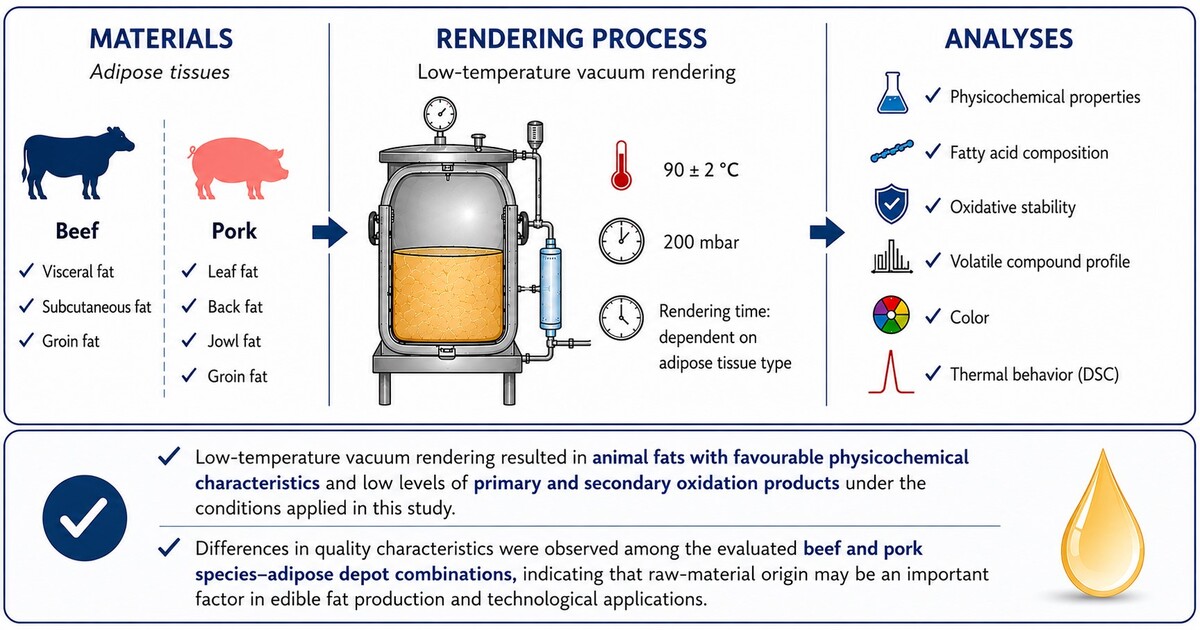
Animal fats are valuable food ingredients owing to their technological, sensory, and functional properties. This study evaluated the influence of animal species and adipose tissue origin on physicochemical characteristics, fatty acid composition, oxidative stability, volatile compound profile, colour, and thermal behaviour of beef tallow and pork lard obtained by low-temperature vacuum rendering (90 ± 2 °C, 200 mbar). Beef visceral, subcutaneous, and groin fat, as well as pork leaf, back, jowl, and groin fat, were rendered under identical processing conditions. Significant differences in fatty acid composition were observed between the analysed fats (P < 0.05). Compared to beef fats, pork fats contained higher proportion of polyunsaturated, omega-3, and omega-6 fatty acids, whereas beef fats had more trans and selected saturated fatty acids. Beef fats were characterised by higher oxidation onset temperatures, indicating greater thermo-oxidative stability. Significant differences were also found in peroxide value, malondialdehyde (MDA) content, colour parameters, and volatile compound profiles. Principal component analysis differentiated the rendered fats according to their volatile fingerprints, reflecting the effects of both animal species and adipose tissue origin on aroma characteristics. Despite compositional differences, all rendered fats showed low acid values, peroxide values, and MDA contents, indicating limited hydrolytic and oxidative deterioration under the applied rendering conditions. These findings indicate that the quality characteristics of rendered fats varied between samples from different species and anatomical fat depots, while low-temperature vacuum rendering was associated with generally favourable lipid composition and limited oxidative changes.
FUNDING
This research was conducted as part of the R&D project No. POIR.01.01.01-00-1066/19, entitled “Innovative functional food fats with increased nutritional, health-promoting and technological value in the system: 'spray-off' and 'friendly use'“. The project was implemented and co-funded by Zakłady Mięsne "Wierzejki" J.M. Zdanowscy Spółka Jawna and co-financed by the National Centre for Research and Development (NCBR) under the Operational Programme Smart Growth 2014–2020.
CONFLICT OF INTEREST
The Authors declare that there is no conflict of interest. The funders had no role in the design of the study; in the collection, analyses, or interpretation of data; in the writing of the manuscript; or in the decision to publish the results.
REFERENCES (32)
1.
Abeyrathne E.D.N.S., Nam K., Ahn D.U., 2021. Analytical methods for lipid oxidation and antioxidant capacity in food systems. Antioxidants 10, 1587, https://doi.org/10.3390/antiox....
2.
Bekhit A.E.D.A., Giteru S.G., Holman B.W.B., Hopkins D.L., 2021. Total volatile basic nitrogen and trimethylamine in muscle foods: Potential formation pathways and effects on human health. Compr. Rev. Food Sci. Food Saf. 20, 3620–3666, https://doi.org/10.1111/1541-4....
3.
Bleicher J., Ebner E.E., Bak K.H., 2022. Formation and analysis of volatile and odor compounds in meat—A review. Molecules 27, 6703, https://doi.org/10.3390/molecu....
4.
Chao Z., Hui C., Jianbo X., 2020. Pyrazines in food. In: J. Xiao, S. Sarker, Y. Asakawa (Editors). Handbook of Dietary Phytochemicals. Springer Nature. Singapore, pp. 1–25, https://doi.org/10.1007/978-98....
5.
Daza A., Ruiz-Carrascal J., Olivares A., Menoyo D., López-Bote C.J., 2007. Fatty acids profile of the subcutaneous backfat layers from Iberian pigs raised under free-range conditions. Food Sci. Technol. Int. 13, 135–142, https://doi.org/10.1177/108201....
6.
Domínguez R., Pateiro M., Gagaoua M., Barba F.J., Zhang W., Lorenzo J.M., 2019. A comprehensive review on lipid oxidation in meat and meat products. Antioxidants 8, 429, https://doi.org/10.3390/antiox....
7.
Dunne P.G., Monahan F.J., O'Mara F.P., Moloney A.P., 2009. Colour of bovine subcutaneous adipose tissue: A review of contributory factors, associations with carcass and meat quality and its potential utility in authentication of dietary history. Meat Sci. 81, 28–45, https://doi.org/10.1016/j.meat....
8.
Gamarra D., Aldai N., Arakawa A., Barron L.J.R., Lopez-Oceja A., de Pancorbo M.M., Taniguchi M., 2018. Distinct correlations between lipogenic gene expression and fatty acid composition of subcutaneous fat among cattle breeds. BMC Vet. Res. 14, 167, https://doi.org/10.1186/s12917....
9.
Hocquette J.F., Gondret E., Médale H., Jurie C., Pethick D.W., 2010. Intramuscular fat content in meat-producing animals: Development, genetic and nutritional control, and identification of putative markers. Animal 4, 303–319, https://doi.org/10.1017/S17517....
10.
Huang Y., Zhou L., Zhang J. et al., 2020. A large-scale comparison of meat quality and intramuscular fatty acid composition among three Chinese indigenous pig breeds. Meat Sci. 168, 108182, https://doi.org/10.1016/j.meat....
11.
Jiang J., Tang X., Xue Y., Lin G., Xiong Y.L., 2017. Dietary linseed oil supplemented with organic selenium improved the fatty acid nutritional profile, muscular selenium deposition, water retention, and tenderness of fresh pork. Meat Sci. 131, 99–106, https://doi.org/10.1016/j.meat....
12.
Kowalski B., 1991. Thermal-oxidative decomposition of edible oils and fats. DSC studies. Thermochim. Acta 184, 49–57, https://doi.org/10.1016/0040-6....
13.
Kowalski B., Ratusz K., Kowalska D., Bekas W., 2004. Determination of the oxidative stability of vegetable oils by Differential Scanning Calorimetry and Rancimat measurements. Eur. J. Lipid Sci. Technol. 106, 165–169, https://doi.org/10.1002/ejlt.2....
14.
Lisitsyn A.B., Chernukha I.M., Lunina O.I., 2017. Fatty acid composition of meat from various animal species and the role of technological factors in transisomerization of fatty acids. Foods Raw Mater. 5, 54–61, https://doi.org/10.21603/2308-....
15.
Meeker D., 2020. Rendering. In: F. Shahidi (Editor). Bailey's Industrial Oil and Fat Products. John Wiley & Sons. Hoboken, NJ (USA), https://doi.org/10.1002/047167....
16.
Mogilnicka I., Bogucki P., Ufnal M., 2020. Microbiota and malodor—Etiology and management. Int. J. Mol. Sci. 21, 2886, https://doi.org/10.3390/ijms21....
17.
Onopiuk A., Kołodziejczak K., Szpicer A., Marcinkowska-Lesiak M., Wojtasik-Kalinowska I., Stelmasiak A., Półtorak A., 2022. The effect of partial substitution of beef tallow on selected physicochemical properties, fatty acid profile and PAH content of grilled beef burgers. Foods 11, 1986, https://doi.org/10.3390/foods1....
18.
Pikul J., Leszczynski D.E., Kummerow F.A., 1989. Evaluation of three modified TBA methods for measuring lipid oxidation in chicken meat. J. Agric. Food Chem. 37, 1309–1313, https://doi.org/10.1021/jf0008....
19.
Polish Committee for Standardization (PKN), 2000. PN-A-86908:2000. Vegetable and Animal Oils and Fats—Refined Vegetable Oils. PKN. Warsaw (Poland).
20.
Rastrelli L., Passi S., Ippolito F., Vacca G., De Simone F., 2002. Rate of degradation of α-tocopherol, squalene, phenolics, and polyunsaturated fatty acids in olive oil during different storage conditions. J. Agric. Food Chem. 50, 5566–5570, https://doi.org/10.1021/jf0110....
21.
Shahidi F., Hossain A., 2022. Role of lipids in food flavor generation. Molecules 27, 5014, https://doi.org/10.3390/molecu....
22.
Shahidi F., Zhong Y., 2010. Lipid oxidation and improving the oxidative stability. Chem. Soc. Rev. 39, 4067–4079, https://doi.org/10.1039/B92218....
23.
Sharma H., Giriprasad R., Goswami M., 2013. Animal fat—Processing and its quality control. J. Food Process. Technol. 4, 252, https://doi.org/10.4172/2157-7....
24.
Shingfield K.J., Bonnet M., Scollan N.D., 2013. Recent developments in altering the fatty acid composition of ruminant-derived foods. Animal 7, 132–162, https://doi.org/10.1017/S17517....
25.
Szpicer A., Onopiuk A., Półtorak A., Wierzbicka A., 2020. The influence of oat β-glucan content on the physicochemical and sensory properties of low-fat beef burgers. CyTA J. Food 18, 315–327, https://doi.org/10.1080/194763....
26.
Wirkowska-Wojdyła M., Ostrowska-Ligęza E., Górska A., Bryś J., 2022. Application of chromatographic and thermal methods to study fatty acids composition and positional distribution, oxidation kinetic parameters and melting profile as important factors characterizing amaranth and quinoa oils. Appl. Sci. 12, 2166, https://doi.org/10.3390/app120....
27.
Wojtasik-Kalinowska I., Górska-Horczyczak E., Stelmasiak A., Marcinkowska-Lesiak M., Onopiuk A., Wierzbicka A., Półtorak A., 2021. Effect of temperature and oxygen dose during rendering of goose fat to promote fatty acid profiles. Eur. J. Lipid Sci. Technol. 123, 2100085, https://doi.org/10.1002/ejlt.2....
28.
Wojtasik-Kalinowska I., Guzek D., Górska-Horczyczak E., Głąbska D., Brodowska M., Sun D.-W., Wierzbicka A., 2016. Volatile compounds and fatty acids profile in Longissimus dorsi muscle from pigs fed with feed containing bioactive components. LWT Food Sci. Technol. 67, 112–117, https://doi.org/10.1016/j.lwt.....
29.
Wood J.D., Enser M., Fisher A.V., Nute G.R., Sheard P.R., Richardson R.I., Hughes S.I., Whittington F.M., 2008. Fat deposition, fatty acid composition and meat quality: A review. Meat Sci. 78, 343–358, https://doi.org/10.1016/j.meat....
30.
Zappaterra M., Catillo G., Belmonte A.M., Fiego D.P.L., Zambonelli P., Steri R., Buttazzoni L., Davoli R., 2020. Genetic parameters of muscle fatty acid profile in a purebred Large White heavy pig population. Meat Sci. 163, 108057, https://doi.org/10.1016/j.meat....
31.
Zhang N., Li Y., Wen S., Sun Y., Chen J., Gao Y., Sagymbek A., Yu X., 2021. Analytical methods for determining the peroxide value of edible oils: A mini-review. Food Chem. 358, 129834, https://doi.org/10.1016/j.food....
32.
Zhang Q., Saleh A.S.M., Chen J., Shen Q., 2012. Chemical alterations taken place during deep-fat frying based on certain reaction products: A review. Chem. Phys. Lipids 165, 662–681, https://doi.org/10.1016/j.chem....
Share
RELATED ARTICLE
| ISSN: | 1230-1388 |

Assigning DOI numbers, introducing articles from supplements and recent publications to POL-index database, maintaining anti-plagiarism detection, electronic system to proceed manuscripts and webpage of the Journal with interactive pdf files, and language correction of manuscripts published in Journal of Animal and Feed Sciences are financed in the years 2018–2019 by the Ministry of Science and Higher Education from the funds for science popularization activities, Agreement No. 631/P-DUN/2018.

© 2006-2026 Journal hosting platform by Bentus
We process personal data collected when visiting the website. The function of obtaining information about users and their behavior is carried out by voluntarily entered information in forms and saving cookies in end devices. Data, including cookies, are used to provide services, improve the user experience and to analyze the traffic in accordance with the Privacy policy. Data are also collected and processed by Google Analytics tool (more).
You can change cookies settings in your browser. Restricted use of cookies in the browser configuration may affect some functionalities of the website.
You can change cookies settings in your browser. Restricted use of cookies in the browser configuration may affect some functionalities of the website.