Current issue
Online first
Archive
About the Journal
Editorial Office
Editorial Board
Copy right and self-archiving policy
Peer review process
Instructions for Reviewers
Printed version subscription
Abstracting and indexing
Contact
Instructions for Authors
Policies
General information
Open Access, Licensing terms, Commercial use and Copyright terms policies
Self-archiving policy and Archive policies
Article Correction and Withdrawal policy
Manuscript Submission policy
Authorship policy
Conflict of Interest policy
Language considerations policy
Plagiarism and Duplicate publications policy
Ethics policy
Review process policy
Acceptance of manuscripts policy
Online First Articles and Special Issues policies
Generative artificial intelligence (AI) policy
Advertising policy
Article publication charges
Policies
General information
Open Access, Licensing terms, Commercial use and Copyright terms policies
Self-archiving policy and Archive policies
Article Correction and Withdrawal policy
Manuscript Submission policy
Authorship policy
Conflict of Interest policy
Language considerations policy
Plagiarism and Duplicate publications policy
Ethics policy
Review process policy
Acceptance of manuscripts policy
Online First Articles and Special Issues policies
Generative artificial intelligence (AI) policy
Advertising policy

ORIGINAL PAPER
Evaluating biomass sorghum genotypes for ensiling purposes: agronomic traits, silage fermentation, and nutritive value
1
Universidade Estadual de Montes Claros, Department of Agricultural Science, Janaúba, 39440-000, Brazil
2
Institute of Animal Science and Pastures. Nova Odessa, São Paulo, Brazil
3
Embrapa Milho e Sorgo, Nova Porteirinha, 39525-000, Brazil
4
Universidade Federal dos Vales do Jequitinhonha e Mucuri, Diamantina, 39100-000, Brazil
Publication date: 2026-11-09
Corresponding author
J.P. S. Rigueira
Universidade Estadual de Montes Claros, Department of Agricultural Science, Janaúba, 39440-000, Brazil
Universidade Estadual de Montes Claros, Department of Agricultural Science, Janaúba, 39440-000, Brazil
KEYWORDS
TOPICS
ABSTRACT
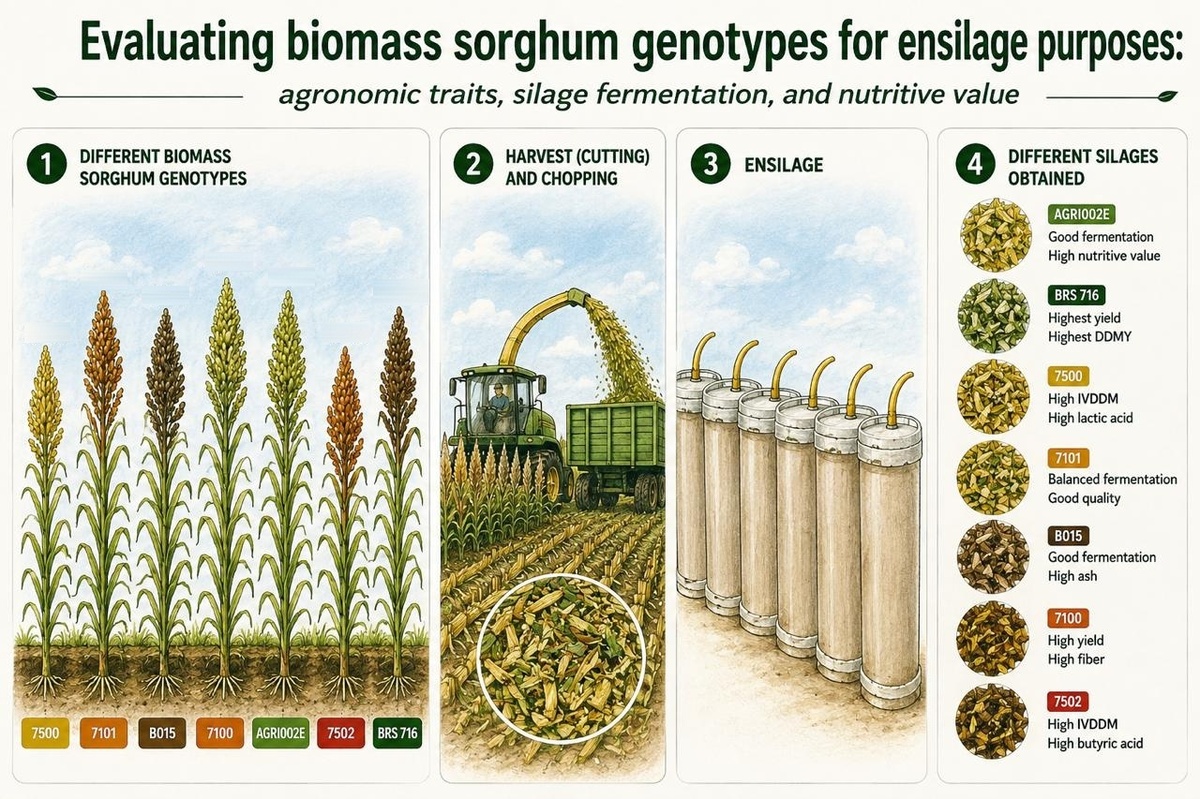
Biomass sorghum (Sorghum bicolor L.) genotypes, although typically selected for bioenergy production, are increasingly considered suitable for producing high-quality silage, and supporting more sustainable forage systems in semiarid regions. This study compared seven genotypes (7500, 7101, B015, 7100, 7502, AGRI002E, and BRS 716) to identify the most optimal for ensiling using a randomised complete block design with three replicates. Genotypes 7500 and 7502 had the lowest dry matter yield (DMY) (14.34 and 11.35 t/ha, respectively), but their silages reached the highest in vitro digestible dry matter (IVDDM) values (506.9 and 528.3 g/kg). The lactic-to-acetic (LA) acid ratios ranged from 1.9 to 3.5, suggesting differences in the relative contribution of homolactic and heterolactic fermentation pathways. While genotype 7500 silage showed the highest ratio (3.5), indicating predominant homolactic fermentation, all silages had suitable pH and ammonia nitrogen levels. Genotype BRS 716 produced the highest DMY (24.50 t/ha) and silage digestible dry matter yield (DDMY) (9.24 t/ha). The first two principal components (PC1 and PC2) accounted for 54.29% of the total variation. BRS 716 was positioned in the upper-right quadrant of the scatter plot, consistent with its superior agronomic performance, with the highest values for fresh matter yield (FMY), DMY, and DDMY. Genotypes 7502 and 7500 were positioned on the left side of the plot and were associated with high silage digestibility, while 7502 was also associated with high silage temperature, and 7500 with high ethanol production. BRS 716 is recommended for ensiling due to its high yield of digestible nutrients per area, suitable fermentation, and potential for large-scale silage production.
ACKNOWLEDGEMENTS
We thank the Maize and Sorghum Center of the Brazilian Agricultural Research Corporation (EMBRAPA) for gently donating the sorghum seeds.
FUNDING
This study was financed in part by the Coordination for the Improvement of Higher Education Personnel (CAPES) – Finance Code 001, the Minas Gerais Research Foundation (FAPEMIG), and the National Council for Scientific and Technological Development (CNPq).
CONFLICT OF INTEREST
The Authors declare that there is no conflict of interest.
REFERENCES (25)
1.
Alvares C.A., Stape J.L., Sentelhas P.C., Gonçalves J.M., Sparovek G., 2013. Köppen’s climate classification map for Brazil. Meteorol. Z. 22, 711-728, https://doi.org/10.1127/0941-2....
2.
Anjos A.N.A., Almeida J.C.C., Viegas C.R., et al., 2022. Protein and carbohydrate profiles of 'Massai' grass silage with pelleted citrus pulp and microbial inoculant. Pesqui. Agropecu. Bras. 57, e02732, https://doi.org/10.1590/S1678-....
3.
Bolsen K.K., Lin C., Brent B.E., Feyerherm A.M., Urban J.E., Aimutis W.R., 1992. Effect of silage additives on the microbial succession and fermentation process of alfalfa and corn silages. J. Dairy Sci. 75, 3066-3083, https://doi.org/10.3168/jds.S0....
4.
Carvalho B.F., Sales G.F.C., Schwan R.F., Ávila C.L.S., 2021. Criteria for lactic acid bacteria screening to enhance silage quality. J. Appl. Microbiol. 130, 341–355, https://doi.org/10.1111/jam.14....
5.
Castro F.M.R., Bruzi A.T., Nunes J.A.R., Parrella R.A.C., Lombardi G.M.R., Albuquerque C.J.B., Lopes M., 2015. Agronomic and energetic potential of biomass sorghum genotypes. Am. J. Plant Sci. 6, 1862-1873, https://doi.org/10.4236/ajps.2....
6.
Detmann E., Silva L.F.C., Rocha G.C., Palma M.N.N., Rodrigues J.P.P., 2025. Methods for Feed Analysis. Suprema. Viçosa.
7.
Diatta-Holgate E., Bergsma B., Tuinstra M.R., 2024. Mutations in the dwarf3 gene confer height stability in sorghum. Plant Genome 17, e20466, https://doi.org/10.1002/tpg2.2....
8.
Figueiredo J.M.M., Parrella R.A.C., Nunes J.A.R., 2024. Genetic parameters and selection for multiple traits in sorghum for forage purposes. Crop Breed. Appl. Biotechnol. 24, e48122429, https://doi.org/10.1590/1984-7....
9.
Guerra J.V., Cavallin I.C., Parrella R.A.C. et al., 2024. Adaptability and stability of biomass sorghum genotypes using GGE Biplot. Rev. Caatinga 38, e12509, https://doi.org/10.1590/1983-2....
10.
IUSS Working Group WRB, 2015. World Reference Base for Soil Resources 2014, Update 2015 International Soil Classification System for Naming Soils and Creating Legends for Soil Maps. FAO. Rome (Italy).
11.
Kung Jr L., Shaver R.D., Grant R.J., Schmidt R.J., 2018. Silage review: Interpretation of chemical, microbial, and organoleptic components of silages. J. Dairy Sci. 101, 4020-4033, https://doi.org/10.3168/jds.20....
12.
Mendes E.V.C., Albuquerque C.J.B., Monção F.P. et al., 2025. Broom-type sorghum cultivars subject to planting densities: agroeconomic responses and forage potential. Cienc. Rural 55, e20240437, https://doi.org/10.1590/0103-8....
13.
Moore K.J., Lenssen A.W., Fales S.L., 2020. Factors affecting forage quality. In: K.J. Moore (Editor). Forages: The Science of Grassland Agriculture, Vol. 2. Wiley. New York (USA), pp. 701-717, https://doi.org/10.1002/978111....
14.
Moran J.P., Weinberg Z.G., Ashbell G., Hen Y., Owen T.R., 1996. A comparison of two methods for the evaluation of the aerobic stability of whole crop wheat silage. In: Proceedings of the 11th International Silage Conference. pp. 162-163.
15.
Pryce J.D., 1969. A modification of the Barker-Summerson method for the determination of lactic acid. Analyst 94, 1151-1152, https://doi.org/10.1039/an9699....
16.
Queiroz F.E., Rocha Júnior V.R., Monção F.P., Rigueira J.P.S., Parrella R.A.C., Rufino L.D.A., Santos A.S., Cordeiro M.W.S., 2021. Effect of row spacing and maturity at harvest on the fermentative profile, aerobic stability, and nutritional characteristics of biomass sorghum (BRS 716) silage in the semiarid region of Brazil. Rev. Bras. Zootecan. 50, e20200254, https://doi.org/10.37496/rbz50....
17.
Rosa M.A.B., Tardin F.D., Souza J.M.S. et al., 2022. Characterization of forage, sweet and biomass sorghum for agronomic performance and ensilability. Rev. Bras. Milho Sorgo 21, e1239, https://doi.org/10.18512/rbms2....
18.
Sales-Silva T.B., Santos M.V.D., Oliveira O.F.D. et al., 2023. The growth habits of tropical legumes affect the nutritive herbage value more than harvesting frequency. Crop Pasture Sci. 75, CP23109, https://doi.org/10.1071/CP2310....
19.
Santos H.G., Jacomine P.K.T., Anjos L.H.C., et al., 2018. Sistema Brasileiro de Classificação de Solos. Embrapa. Brasília (Brazil).
20.
Silva P.H.F., Sales T.B., Lemos M.F. et al., 2021. Tall and short-sized elephant grass genotypes: morphophysiological aspects cut-and-carry, and grazing management. Cienc. Rural 51, e20200848, https://doi.org/10.1590/0103-8....
21.
Silva Y.A., Orrico Junior M.A., Retore M., Ceccon G., Fernandes T., Orrico A.C., 2025. Chemical composition, fermentation parameters and losses of silages from different hybrids of biomass sorghum. Grass Forage Sci. 80, e12706, https://doi.org/10.1111/gfs.12....
22.
Souza Í.D.A., Rocha Júnior V.R., Monção F.P. et al., 2021. Yield and nutritional value of biomass sorghum (BRS 716) managed in different row spacing and maturity at harvest in the semiarid region of Brazil. Semina-Cienc. Agrar. 42, 3463-3484, https://doi.org/10.5433/1679-0....
23.
Souza J.F., Rigueira J.P.S., Albuquerque C.J. et al., 2023. Yield and nutritional value of silage of different sorghum hybrids inoculated with Azospirillum brasilense. J. Appl. Anim. Res. 51, 424-433, https://doi.org/10.1080/097121....
24.
Wilkinson J.M., 2015. Managing silage making to reduce losses. Livestock 20, 280-286, https://doi.org/10.12968/live.....
25.
Yang L., Zhou Q., Sheng X. et al., 2023. Harnessing the genetic basis of sorghum biomass-related traits to facilitate bioenergy applications. Int. J. Mol. Sci. 24, 14549, https://doi.org/10.3390/ijms24....
| ISSN: | 1230-1388 |

Assigning DOI numbers, introducing articles from supplements and recent publications to POL-index database, maintaining anti-plagiarism detection, electronic system to proceed manuscripts and webpage of the Journal with interactive pdf files, and language correction of manuscripts published in Journal of Animal and Feed Sciences are financed in the years 2018–2019 by the Ministry of Science and Higher Education from the funds for science popularization activities, Agreement No. 631/P-DUN/2018.

© 2006-2026 Journal hosting platform by Bentus
We process personal data collected when visiting the website. The function of obtaining information about users and their behavior is carried out by voluntarily entered information in forms and saving cookies in end devices. Data, including cookies, are used to provide services, improve the user experience and to analyze the traffic in accordance with the Privacy policy. Data are also collected and processed by Google Analytics tool (more).
You can change cookies settings in your browser. Restricted use of cookies in the browser configuration may affect some functionalities of the website.
You can change cookies settings in your browser. Restricted use of cookies in the browser configuration may affect some functionalities of the website.